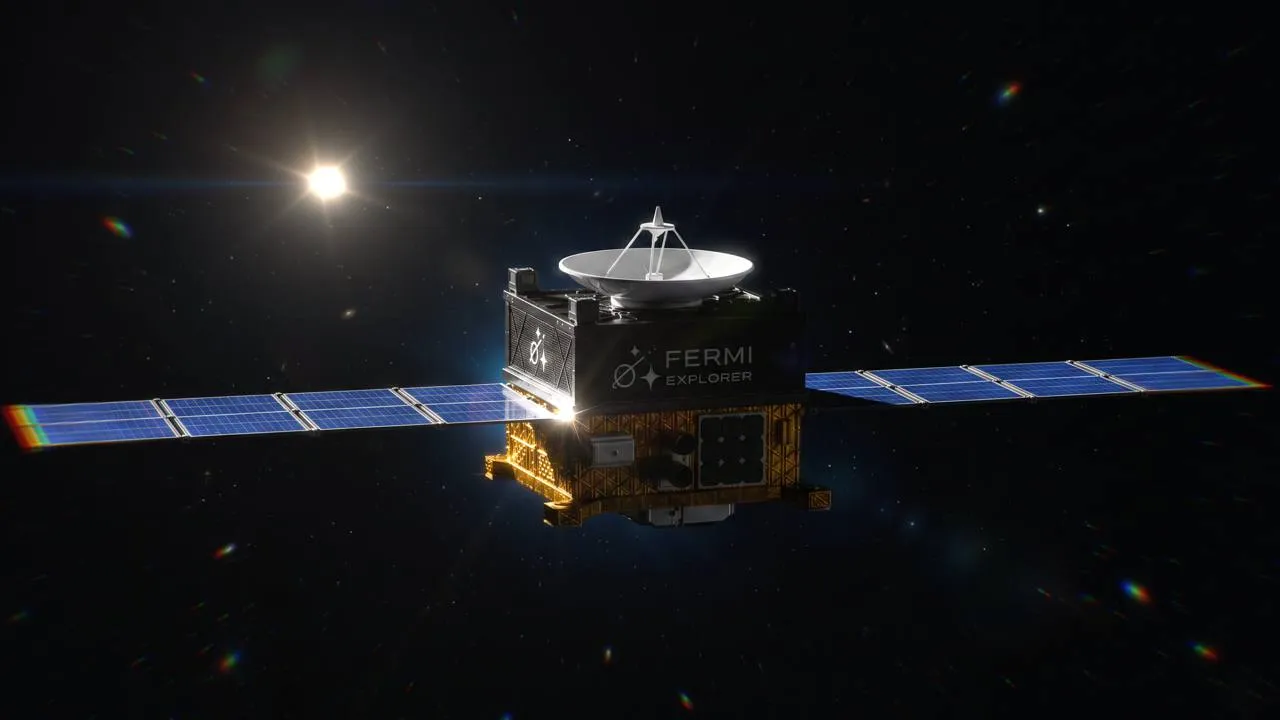
A Private-Sector Bid to Begin Humanity’s First Interstellar Journey
A newly announced private initiative called Fermi Explorer aims to launch a small spacecraft toward the Alpha Centauri star system as early as 2029, pursuing what its organizers describe as a practical and affordable first step into interstellar exploration.
Unlike high-profile concepts that rely on breakthrough propulsion technologies, Fermi Explorer proposes using existing spacecraft systems and orbital mechanics to place a probe on a trajectory toward the nearest stellar system to Earth. The team says the mission could be developed for approximately $15 million, a remarkably small budget compared with most deep-space exploration programs.
The spacecraft would carry a payload of roughly one kilogram and would not attempt to reach Alpha Centauri within a human lifetime. Instead, the mission is intended as a proof-of-concept demonstration that interstellar travel is technically achievable using currently available technology.
Mission Architecture Relies on Solar-System Maneuvers
The proposed mission architecture avoids exotic propulsion systems and instead exploits repeated close approaches to the Sun.
After launching on a rideshare mission to low Earth orbit, the spacecraft would gradually reduce its perihelion—the closest point of its orbit to the Sun—through a series of carefully planned orbital maneuvers. At each close solar pass, the probe would perform propulsion burns while benefiting from the Oberth effect, which allows engines to generate larger velocity changes when operating at high speeds deep within a gravitational well.
According to the mission concept, these “perihelion pump” maneuvers would continue for roughly 12 years before the spacecraft finally achieves solar-system escape velocity. The resulting outbound speed is projected to reach approximately 25 kilometers per second.
At that velocity, the spacecraft would require about 77,000 years to reach Alpha Centauri, making the mission fundamentally symbolic rather than scientific in the traditional sense.
Testing the Fermi Paradox Through Action
The project draws inspiration from the Fermi Paradox—the apparent contradiction between the vast number of potentially habitable worlds in the galaxy and the absence of evidence for extraterrestrial civilizations.
Mission organizers argue that humanity has spent decades discussing interstellar exploration without actually launching a spacecraft intended to leave the Solar System for another star. By placing even a small probe on a genuine interstellar trajectory, they hope to demonstrate that such missions are not merely theoretical.
From a philosophical perspective, the spacecraft would become humanity’s first deliberate attempt to send an artifact toward another stellar system rather than merely beyond the heliosphere.
Engineering Challenges Remain Significant
Although the mission avoids speculative propulsion technologies, it still faces substantial engineering hurdles.
Repeated close solar encounters expose spacecraft systems to intense thermal loads. Any vehicle approaching well inside Earth’s orbital distance must withstand solar heating far greater than that experienced by most planetary probes. Thermal protection systems, power management, communications equipment, and propulsion hardware would all require long-duration reliability during a mission expected to spend more than a decade performing orbital adjustments before beginning its interstellar cruise.
The mission also presents unusual spacecraft operations challenges. Maintaining spacecraft health over a 12-year maneuvering campaign demands highly reliable avionics, propulsion components, and autonomous navigation systems. While these requirements are less demanding than those of flagship NASA missions, they remain ambitious for a privately funded spacecraft with a comparatively modest budget.
From an Assembly, Integration and Testing (AIT) perspective, long-life qualification of critical subsystems would likely become one of the program’s most important development tasks. Demonstrating propulsion-system durability over many years could prove just as important as achieving the final escape trajectory.
A Different Approach from Breakthrough Starshot
Fermi Explorer enters a field already populated by more ambitious interstellar concepts.
The most prominent example is Breakthrough Starshot, the privately funded initiative that proposed sending gram-scale spacecraft to Alpha Centauri using powerful ground-based lasers and light sails. That concept aims for velocities approaching 20% of the speed of light, potentially reaching the star system in roughly two decades rather than tens of thousands of years.
However, Starshot depends on technologies—including multi-gigawatt laser arrays and ultra-light spacecraft—that remain far from operational deployment. Fermi Explorer’s strategy is almost the opposite: accept extremely long travel times in exchange for using technology that largely exists today.
This distinction may make the project more achievable in the near term, even if its scientific return is limited.
Growing Interest in Alpha Centauri
Alpha Centauri continues to attract attention as the most accessible destination beyond the Solar System. The system lies approximately 4.3 light-years from Earth and includes the stars Alpha Centauri A, Alpha Centauri B, and Proxima Centauri. Astronomers have already identified at least one Earth-sized planet orbiting Proxima Centauri within its habitable zone, increasing interest in future exploration efforts.
Numerous government and private studies have examined missions to the system, ranging from laser-propelled nanocraft to nuclear-powered spacecraft concepts. Yet none has progressed beyond conceptual or research phases.
If launched, Fermi Explorer would not be the fastest or most technologically advanced interstellar proposal. Its significance would instead lie in crossing a symbolic threshold: becoming one of the first spacecraft intentionally dispatched toward another star system.
Whether the project secures funding and reaches its 2029 launch target remains uncertain. But the initiative reflects a broader trend in the space sector, where private organizations are increasingly pursuing goals once considered exclusively the domain of national space agencies.