U.S. startup Mantis Space has raised $10 million in seed funding to develop technology designed to transmit solar power between satellites in orbit using laser beams.
The financing round was led by Rule 1 Ventures with additional participation from Montauk Capital, an incubator backing the company. Mantis Space said the funds will be used to complete development of its prototype payload and expand its workforce.
The company has also secured roughly $25 million in financial support and tax incentives from the state of New Mexico and the city of Albuquerque, according to Eric Truitt.
Mantis Space is developing a system intended to address a persistent challenge for satellites: maintaining reliable power while passing through the Earth’s shadow. Although satellites generate electricity using solar panels, they still require large batteries to operate during periods of darkness.
Satellites typically spend about one-third of their time in shadow, Truitt said, which forces operators to rely on heavy battery systems or optimize orbital paths to maximize exposure to sunlight.
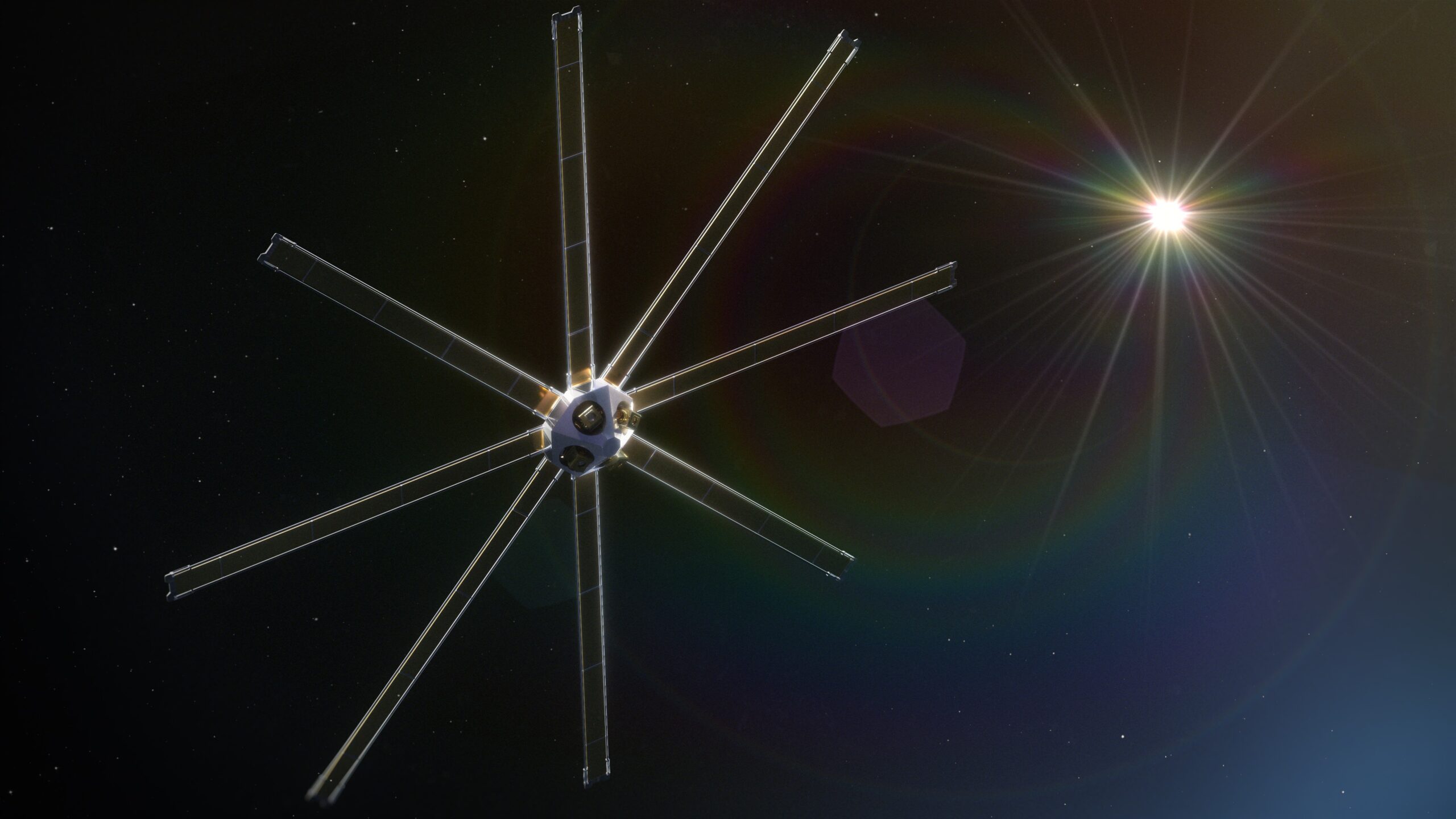
Mantis Space proposes a different approach by centralizing solar energy generation in orbit. Under the concept, satellites equipped with large solar arrays would operate at higher altitudes above Low Earth Orbit congestion and transmit energy via laser beams to customer satellites operating in shadow.
By using military-grade lasers and a wavelength optimized for power generation, the company says its transmitted energy could be 20% to 30% more efficient than direct sunlight received by the target satellites.
“It’s kind of an elegant solution because you’re safer to the satellite, and you help them generate more power in the same amount of time,” Truitt said.
Mantis aims to launch its first system in early 2028. The initial payload is expected to include up to four laser beams per satellite, enabling the system to transmit energy to multiple spacecraft simultaneously.
The company believes the technology could support a growing range of power-intensive orbital activities, including in-space manufacturing, satellite data processing, and other infrastructure projects requiring higher energy output.
As the number of satellites and space-based applications expands, Mantis says its approach could help reduce congestion by allowing spacecraft to operate in less crowded orbits while still receiving power.
“Ultimately, we see a future where we can provide more than one Sun of power,” Truitt said. “So, you can charge in half the time, or a quarter of the time. That means, on a per-hour basis, you can even multiply that higher—so we could service 20, 30, 40 satellites an hour.”