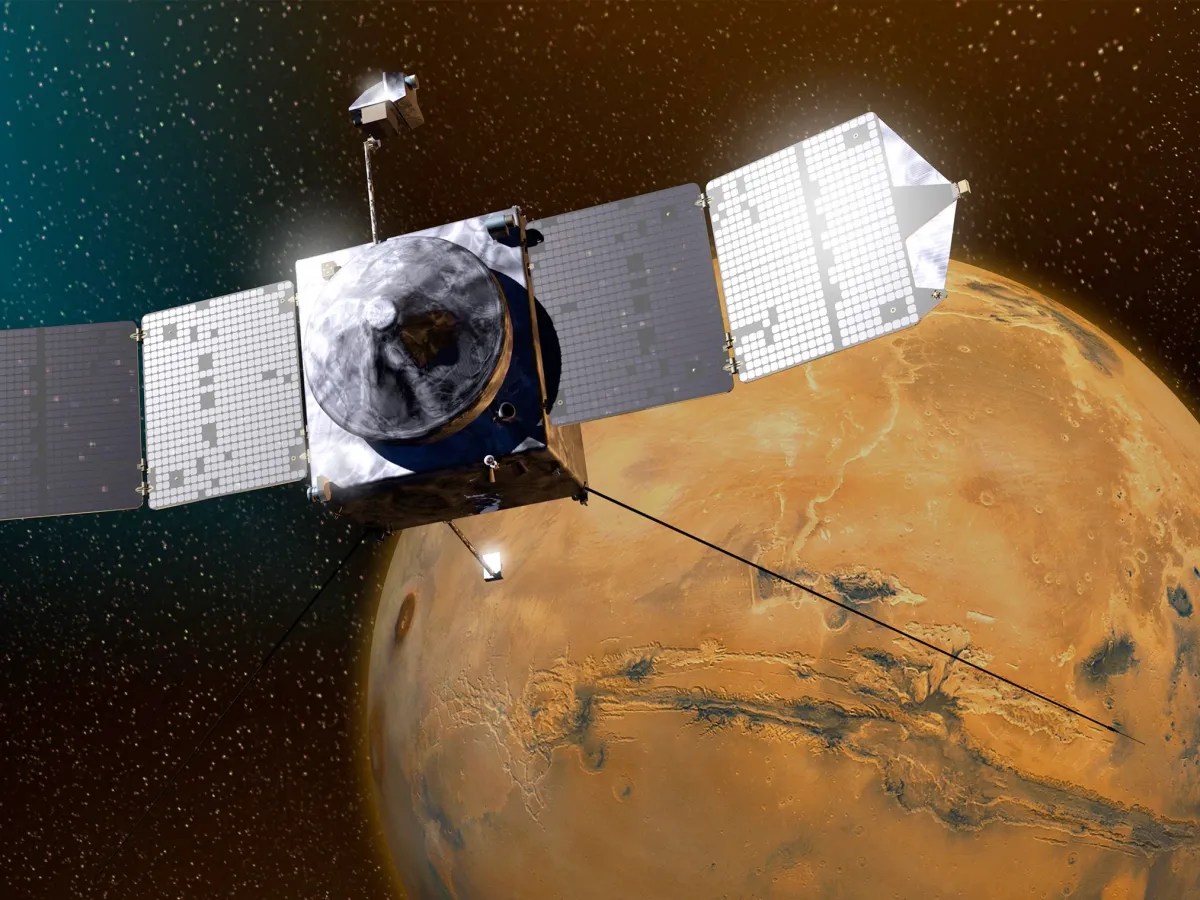
NASA has officially declared the end of its MAVEN mission after the spacecraft orbiting Mars became unresponsive and could not be recovered following a communications loss that began in December.
The agency confirmed the mission’s conclusion on Wednesday, bringing to a close more than a decade of scientific observations of the Red Planet.
Contact Lost After Orbit Disruption
MAVEN, short for Mars Atmosphere and Volatile Evolution, was launched in 2013 to study the Martian atmosphere and investigate how the planet lost much of its air and water over billions of years.
The spacecraft fell silent in early December after passing behind Mars. Data received before contact was lost indicated that MAVEN entered a rapid spin, disrupting its orbit and depleting its onboard batteries.
A NASA review board later concluded that the spacecraft could not be recovered and that mission operations should be terminated.
Remaining in Martian Orbit
Although no longer operational, MAVEN is expected to remain in orbit around Mars for another 50 to 100 years before eventually entering the planet’s atmosphere.
NASA said the inactive spacecraft poses no immediate risk to other missions operating around Mars.
An investigation into the cause of the anomaly remains ongoing.
Scientific Legacy
Throughout its mission, MAVEN provided valuable insights into the structure, composition and evolution of the Martian atmosphere.
The spacecraft also contributed to studies of Martian weather and observed an interstellar comet that passed through the solar system last year.
In addition, MAVEN played a key role as a communications relay, transmitting data between Earth and NASA’s Curiosity and Perseverance rovers operating on the Martian surface.
Other Missions Continue
NASA officials said scientific operations on Mars will continue without interruption.
Four other spacecraft currently orbiting Mars — two operated by the United States and two by European agencies — will continue supporting communications and scientific observations.
“The team really did experience the loss of a loved one with the end of the mission here,” said NASA project manager Mike Moreau.
MAVEN principal investigator Shannon Curry of the University of Colorado Boulder said the mission significantly advanced scientific understanding of the Martian atmosphere.
“The team is certainly broken up about this,” Curry said.
“But at the same time we are incredibly proud of the science we’ve accomplished over the last decade.”
The mission’s findings are expected to remain an important part of Mars research for years to come as scientists continue to study the planet’s climate history and potential habitability.