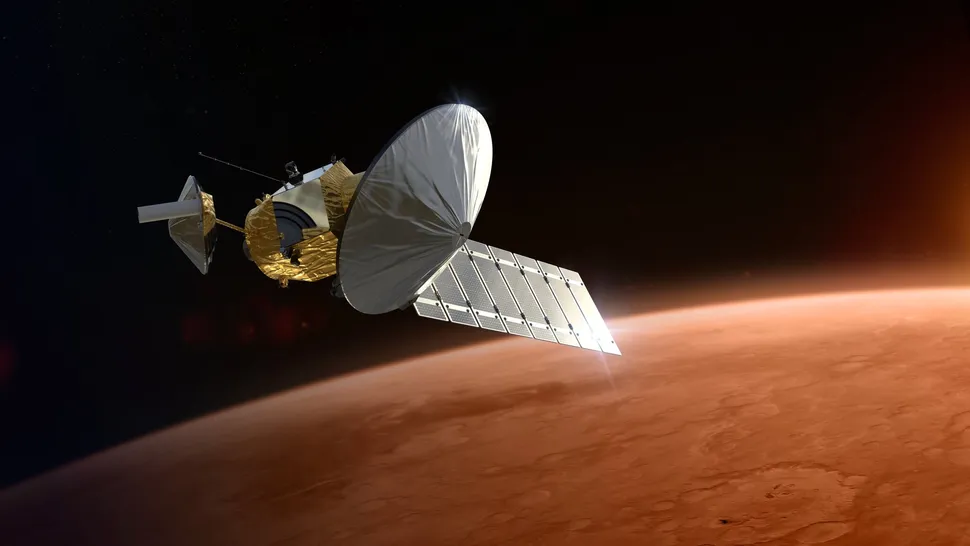
Rocket Lab filed a formal protest with the U.S. Government Accountability Office on September 11, challenging NASA’s decision to award Blue Origin a $700 million contract to develop, launch and operate the Mars Telecommunications Network. NASA selected Blue Origin on September 1 for the communications orbiter, which must be delivered by December 31, 2028 and is expected to enter service at Mars by 2030.
Rocket Lab said NASA’s award decision appeared inconsistent with eligibility requirements established by Congress. The company also alleged that NASA conducted an inconsistent and “punitive” review of its technical proposal, leading the agency to make incorrect assertions and conclusions.
The company has not publicly released its proposal or detailed the specific evaluation findings it is contesting. Its protest places the focus on both Blue Origin’s eligibility for the procurement and NASA’s assessment of competing spacecraft designs.
Rocket Lab said federal procurement standards are intended to protect fair competition and public investment, describing the Mars communications system as critical infrastructure that could support U.S. exploration activities for decades.
The GAO review will determine whether NASA followed applicable procurement law and the terms of its solicitation. Possible outcomes include denying or sustaining the protest, dismissing it on procedural grounds, or prompting NASA to take corrective action. Such action could involve revising the evaluation, reopening discussions with bidders or conducting a new source-selection decision.
A Dedicated Communications Orbiter for Mars
Despite its name, the Mars Telecommunications Network currently consists of a single planned spacecraft. The orbiter is intended to provide high-bandwidth communications and navigation services between Earth and robotic missions operating on or around Mars, rather than making scientific observations its primary task.
NASA currently relies heavily on Mars Odyssey and the Mars Reconnaissance Orbiter to relay commands and data for surface missions including the Curiosity and Perseverance rovers. Odyssey launched in 2001, while the Mars Reconnaissance Orbiter launched in 2005. The European Space Agency’s Mars Express and Trace Gas Orbiter also contribute relay capacity.
Those spacecraft carry their own science instruments and divide their operational resources between research and communications support. A purpose-built relay platform would give NASA additional capacity as its existing orbiters age and as future missions generate larger volumes of data.
Congress provided $700 million for a new Mars telecommunications orbiter in July 2025. NASA issued initial requirements in February 2026 and released its request for proposals in May, with Blue Origin and Rocket Lab emerging as the principal competitors.
Blue Origin Proposed Blue Ring-Based Spacecraft
Blue Origin plans to derive the Mars orbiter from its Blue Ring spacecraft platform. The architecture combines solar-electric and chemical propulsion and is being developed for payload transport, hosting and maneuvering missions across multiple orbital regimes.
A prototype associated with Blue Ring flew aboard the inaugural New Glenn mission in January 2025, although the platform has not yet completed an operational mission. Blue Origin has said its Mars configuration could transport additional payloads to Martian orbit or the surface, alongside its primary telecommunications role.
NASA’s contract makes Blue Origin responsible for the full mission chain: spacecraft design, development, integration, launch and operations. The launch vehicle has not been formally confirmed, although New Glenn is an apparent candidate and Blue Ring is designed to be compatible with other rockets.
Blue Origin previously used the GAO protest process after NASA selected SpaceX in 2021 to provide the first crewed lunar lander for the Artemis program. The GAO denied that protest, and Blue Origin subsequently lost a related federal lawsuit. NASA later held a separate competition for a second Artemis lander, awarding that contract to Blue Origin in 2023.
For the Mars Telecommunications Network, the protest outcome will determine whether NASA can continue with Blue Origin under the existing award or must revisit the procurement. If the award stands, the program will face a compressed development, integration and launch schedule to meet the December 31, 2028 delivery deadline and begin operations at Mars by 2030.