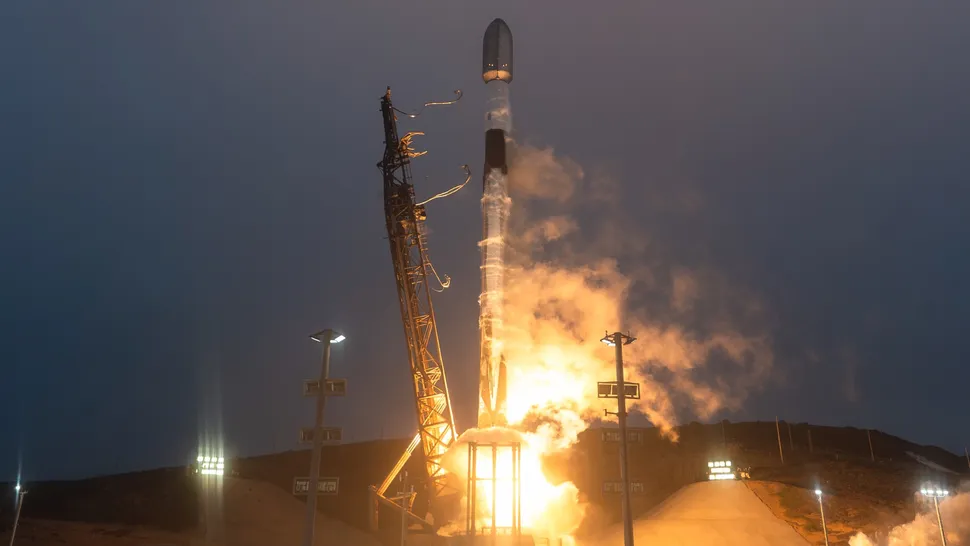
SpaceX launched 27 Starlink V2 Mini satellites from Vandenberg Space Force Base in California on September 19, adding another batch of broadband spacecraft to its low Earth orbit constellation. The Falcon 9 mission also marked the 17th flight of first-stage booster B1093, which landed on a drone ship in the Pacific Ocean.
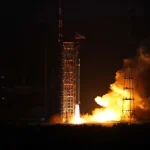
The rocket lifted off from Space Launch Complex 4 East at 6:47 p.m. PDT on Saturday, September 19, or 01:47 UTC on September 20. Falcon 9 followed a southeasterly trajectory along the California coast before its two stages separated.
About 8.5 minutes after liftoff, B1093 completed its return by landing on the autonomous drone ship Of Course I Still Love You. The recovery was the vessel’s 225th successful booster landing and the 662nd landing of a Falcon first stage across SpaceX’s land- and sea-based recovery operations.
The Falcon 9 upper stage continued toward low Earth orbit with the 27 satellites, which were deployed approximately one hour after launch.
A 17-Flight Booster
B1093 previously supported two missions for the U.S. Space Force’s Space Development Agency, the Transporter-16 rideshare mission and 13 earlier Starlink launches. The September 19 flight brought the booster’s total to 17 launches and landings.
That flight history illustrates how booster reuse has become central to SpaceX’s launch model. By assigning flight-proven stages to repeated constellation missions, the company can maintain a high launch cadence without manufacturing a new first stage for every flight. The approach also allows Falcon 9 missions to share a common pool of boosters across commercial, government and internal Starlink launches.
The mission was SpaceX’s 81st dedicated Starlink launch of 2026. Starlink deployments account for most of the company’s flight activity, providing a steady internal customer for Falcon 9 while expanding orbital capacity for broadband services.

Continuing the V2 Mini Deployment
The Starlink 15-27 mission carried the optimized version of SpaceX’s V2 Mini spacecraft. These satellites are designed to provide greater communications capacity than earlier Starlink generations while remaining compatible with Falcon 9’s payload envelope.
After release into an initial low orbit, the satellites use onboard propulsion to raise themselves toward their operational positions. Deploying spacecraft below their final altitude allows SpaceX to verify their condition before orbit raising and enables malfunctioning satellites to reenter the atmosphere relatively quickly because of atmospheric drag.
Falcon 9 remains the primary launch vehicle for Starlink, but SpaceX intends to shift future deployment toward larger Starlink V3 satellites carried by Starship. Starship’s greater payload volume and mass capacity are expected to allow substantially more network capacity to be placed into orbit on each mission. Until that vehicle begins operational constellation launches, frequent Falcon 9 missions will remain essential to replenishing and expanding the network.