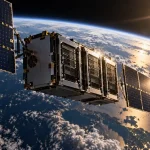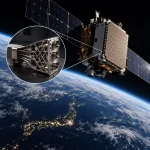
SpaceX launched three Boeing-built O3b mPOWER communications satellites for SES on September 13, completing the Luxembourg-based operator’s 13-satellite medium Earth orbit constellation while marking the 700th mission by SpaceX’s Falcon rocket family.
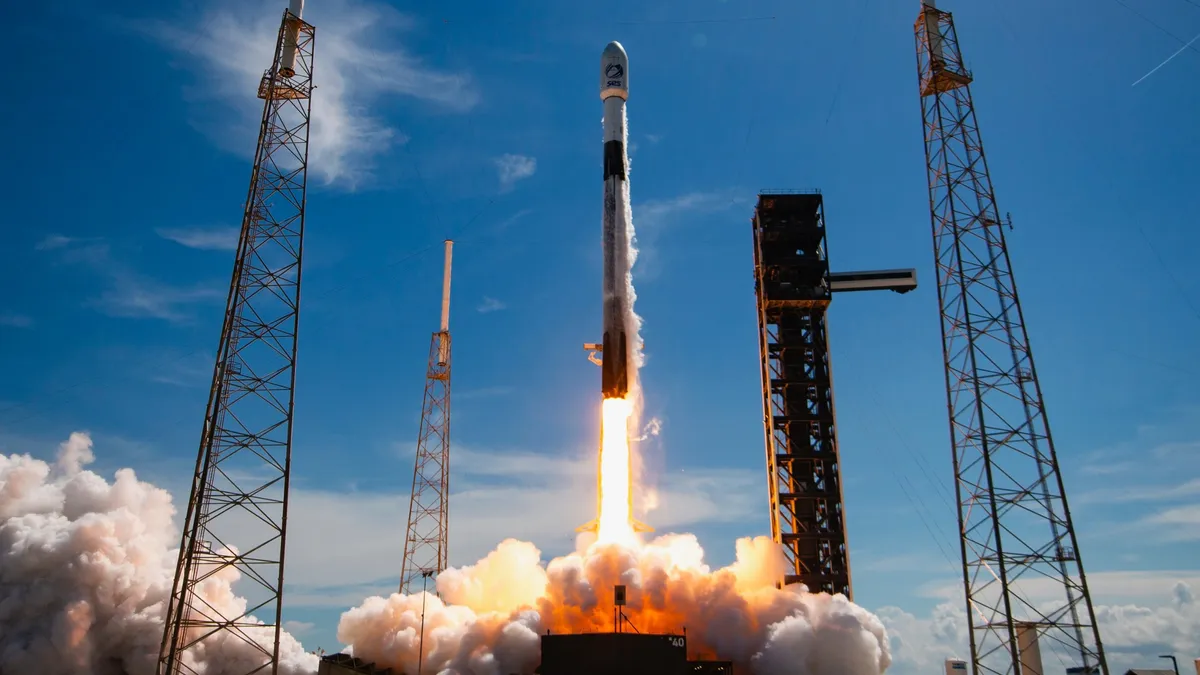
A Falcon 9 lifted off from Space Launch Complex 40 at Cape Canaveral Space Force Station in Florida at 2:49 p.m. EDT, or 18:49 UTC. The mission was SpaceX’s 107th orbital launch of 2026 and the 105th Falcon 9 flight of the year, with Falcon Heavy accounting for the company’s other two orbital missions.
The rocket’s first stage, designated B1080, landed on the drone ship A Shortfall of Gravitas in the Atlantic Ocean less than nine minutes after liftoff. The recovery completed the booster’s 29th flight, continuing SpaceX’s use of high-flight-count hardware for commercial satellite deployments.
A SpaceX Falcon 9 rocket launched the SES O3b mPOWER mission from Space Launch Complex 40 (SLC-40) at Cape Canaveral Space Force Station in Florida on Sept. 13, 2026. Credit: SpaceX
B1080 previously supported the Ax-2 and Ax-3 private astronaut missions, NASA’s CRS-30 cargo mission to the International Space Station, the European Space Agency’s Euclid space telescope launch, SES’s ASTRA 1P mission, Northrop Grumman’s NG-21 cargo flight and 22 Starlink launches.
The Falcon 9 upper stage continued toward medium Earth orbit with the three O3b mPOWER spacecraft. Deployment began approximately 33.5 minutes after launch at an altitude of about 8,000 kilometers and took place over a 14-minute period.
Each satellite has a launch mass of approximately 1,700 kilograms. SpaceX deployed all 13 O3b mPOWER spacecraft across six Falcon 9 missions beginning in December 2022.
Completing SES’s Next-Generation MEO Network
The three newly launched satellites will join 10 O3b mPOWER spacecraft already operating in medium Earth orbit. SES designed the constellation to deliver high-throughput, low-latency connectivity to customers requiring reliable broadband links, including telecommunications operators, governments, cloud service providers, maritime users and other enterprises operating beyond terrestrial network coverage.
O3b mPOWER uses software-defined satellites and a supporting ground and network-management system that can allocate capacity according to changing customer demand. Unlike conventional wide-beam communications satellites, the architecture can direct and reshape connectivity resources across multiple service areas.
Operating in medium Earth orbit also places the spacecraft substantially closer to users than traditional geostationary communications satellites, which orbit at an altitude of nearly 35,800 kilometers. The shorter signal path reduces latency, while a multi-satellite constellation maintains service as individual spacecraft move across the sky.
Completing the deployment shifts the program’s emphasis from constellation construction toward integration, commissioning and commercial service expansion. The final satellites must undergo in-orbit testing before contributing operational capacity to the network.
The launch also illustrates the role of repeatable launch services in deploying distributed communications infrastructure. Six missions were required to place the complete O3b mPOWER constellation into orbit, making schedule consistency, spacecraft integration and access to the required orbital regime important elements of the deployment campaign.
Falcon Family Reaches 700 Missions
The mission was the 700th launch by the Falcon rocket family, which began with the first Falcon 1 flight in March 2006. Falcon 1 flew five times, achieving orbit on its final two missions before SpaceX transitioned to the larger Falcon 9 in 2010.
Falcon 9 has since conducted the overwhelming majority of Falcon missions, supporting commercial satellites, NASA crew and cargo flights, national security payloads, interplanetary spacecraft and SpaceX’s Starlink constellation. Falcon Heavy, the family’s active heavy-lift variant, has flown 13 times.
SpaceX has also conducted two suborbital Starship test flights in 2026 and is preparing another flight expected to attempt an orbital mission. While Starship is intended eventually to assume a much larger share of SpaceX’s launch activity, the O3b mPOWER deployment demonstrates that Falcon 9 remains the company’s principal operational vehicle for commercial missions.