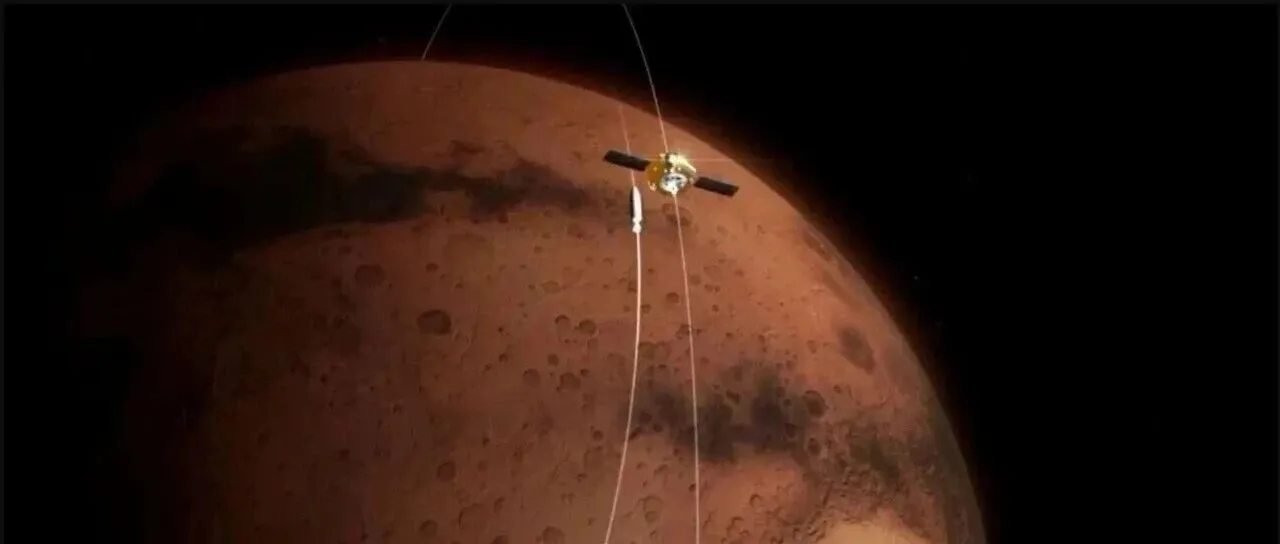
As a key step in China’s planetary exploration program, the Tianwen-3 Mars sample return mission is expected to become the first successful Mars sample return mission in human history. At the 2026 Deep Space Exploration (Tiandu) International Conference held on September 3, Academician Hou Zengqian of the Chinese Academy of Sciences, the chief scientist of the Tianwen-3 mission, said in an interview with Xinhua that searching for potential signs of life on Mars is the mission’s primary scientific objective. The final landing site is expected to be determined by the end of 2026, while Chinese scientists are advancing the compilation of a new-generation global geological map of Mars.
Q: Why was “searching for potential signs of life on Mars” established as the primary scientific objective?
A: Mars is one of the most Earth-like terrestrial planets in the Solar System and is widely recognized as a celestial body that may have once supported life beyond Earth. Early Mars had liquid water and environments potentially suitable for sustaining life. Today, Mars has entered an old evolutionary stage, with its global magnetic field gone, its atmosphere thin, and its surface dry and cold. However, the evolution of its past habitability and the possibility of life having existed there remain among the most fundamental frontier questions in planetary science.
Over the past half-century, 47 Mars exploration missions have been conducted worldwide, achieving flybys, orbital exploration, landing, and surface roving missions. However, more challenging objectives such as sample return and crewed exploration have yet to achieve decisive breakthroughs. From the biological experiments conducted by the Viking missions to debates surrounding the ALH84001 meteorite, from the discovery of hydrated silica by the Spirit rover to the detection of long-chain organic molecules by Curiosity, all findings have allowed multiple interpretations and have been unable to provide a definitive answer to whether life ever existed on Mars.
By making the search for potential signs of life on Mars its primary scientific objective, Tianwen-3 aims to collect high-value Martian samples and return them to Earth for detailed analysis, systematically searching for evidence of whether life exists or once existed. The mission will investigate microbial traces similar to early forms of life on Earth while also considering unknown life forms that may have emerged through Mars’ unique evolutionary pathway. It will provide critical empirical evidence to address this major scientific question, while deepening systematic understanding of Martian climate evolution and geological processes and advancing comparative planetology and studies on the origins of life.
Q: Mars sample return is widely considered one of the most challenging space missions. What are the core technical challenges, and what independent innovations have been developed to address them?
A: Mars sample return is an extremely complex systems engineering project. The core challenges mainly include three aspects.
The first is “where to collect samples.” Site selection is the first key factor determining the scientific value of returned samples. We are currently considering factors including geological age, the history of water activity, habitability, and the potential for preserving life signatures. Eight candidate landing regions have been initially selected to maximize the probability of obtaining scientifically valuable samples. The final landing site is expected to be determined by the end of 2026.
The second is the “three non-contamination” protection system. Strict planetary protection and contamination control measures will be implemented. China will establish the world’s first planetary protection laboratory and build a two-way protection system: preventing terrestrial microorganisms from contaminating Mars, ensuring returned samples are safely isolated without posing risks to Earth, and minimizing contamination of Martian samples by terrestrial organisms and materials.
The third is identifying life signatures, which represents the ultimate goal of the mission. To address the challenge of detecting extremely trace amounts of biological materials, we are conducting dedicated research on life-signature detection, developing technologies to identify and analyze ultra-trace life-related materials in samples, and establishing a high-fidelity, end-to-end life-signature recognition methodology for returned Martian samples. These efforts will create advanced analytical methods, identification systems, and theoretical frameworks to support the search for life signatures in Tianwen-3 samples.
Work on related key technologies is progressing, and the mission has entered the preliminary prototype development phase.
Q: Beyond sample return itself, what long-term impacts will this mission have on China’s deep space exploration and planetary science?
A: Mars sample return is both a comprehensive test of engineering capabilities and a major driver for the development of planetary science. Its impact will extend across technology, scientific disciplines, and exploration capabilities. The mission reflects China’s deep space exploration efforts moving toward deeper integration of scientific objectives and engineering capabilities, with major scientific questions guiding mission design and implementation.
An important project currently underway is the compilation of a new-generation global geological map of Mars. Based on the concept of “data-driven and intelligent mapping,” the project will make full use of data obtained by the Tianwen-1 mission, integrate international multi-source datasets, combine multimodal information including imagery, spectroscopy, radar, and gravity measurements, and highlight new scientific understanding of Martian geological evolution. It will also introduce artificial intelligence technologies for intelligent geological interpretation. This will be the world’s first intelligent geological map of Mars, with the 1:5 million-scale Global Geological Map of Mars Version 1.0 planned for completion by the end of 2028.
Regardless of whether life signatures are discovered, returned Martian samples will have irreplaceable scientific value. Using advanced laboratories on Earth, scientists will be able to study Martian materials at microscopic, molecular, and isotopic scales, deepening understanding of Mars’ geology, environment, habitability evolution, and the conditions for the origin of life.
Deep space exploration is an important indicator of a country’s scientific and technological strength and innovation capability. Tianwen-3 will uphold the principle of open cooperation, work with global scientific communities to explore the mysteries of Mars, and contribute Chinese knowledge and solutions to expanding humanity’s frontier of understanding and advancing planetary science.
Tianwen-3, China’s Mars sample return mission, is planned as the next major step following the Tianwen-1 Mars exploration mission. If successful, it would mark a historic milestone in planetary exploration by returning samples from Mars to Earth for the first time, enabling scientists worldwide to conduct analyses that are impossible with current in-situ instruments.