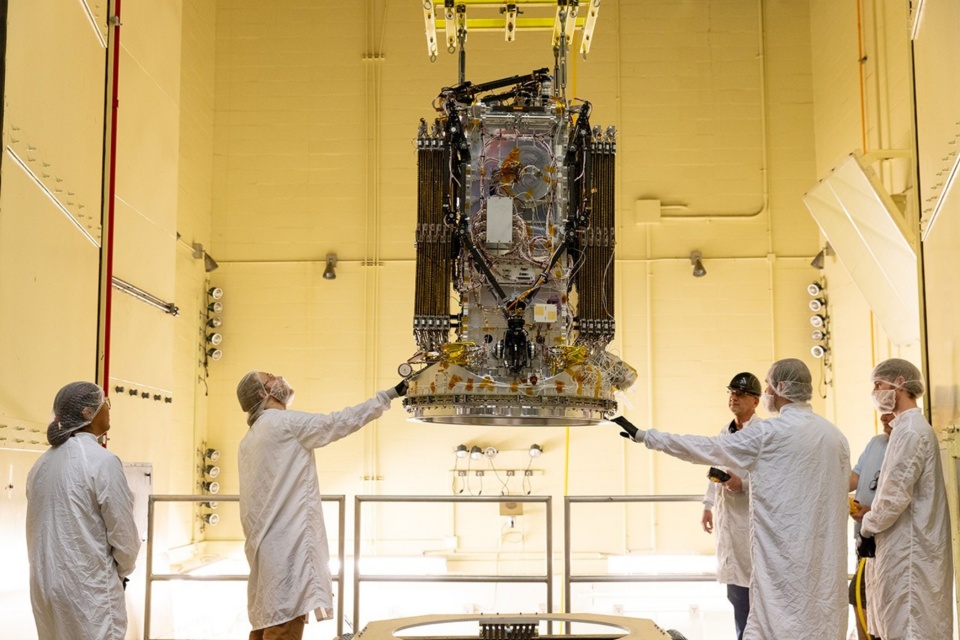
Katalyst Space has secured $12 million in new funding to support the development of its first geostationary orbit (GEO)-capable robotic servicing spacecraft, NEXUS, which is scheduled to launch aboard an Arianespace Ariane 6 rocket in 2027.
The funding round was led by Geodesic Capital, with participation from Fortitude Ventures and several undisclosed investors.
The capital will help accelerate development of NEXUS, a next-generation spacecraft designed to perform a variety of in-space servicing missions, including satellite inspections, space domain awareness operations and life-extension services.
NASA Mission Scheduled for June Launch
Before deploying NEXUS, Katalyst Space is preparing for an important demonstration mission closer to Earth.
Under a $30 million contract awarded by NASA in September, the company will launch its LINK robotic spacecraft later this month to rendezvous and dock with NASA’s Neil Gehrels Swift Observatory.
The mission aims to boost the orbit of the space telescope, which would otherwise be expected to re-enter Earth’s atmosphere later this year.
LINK has already been integrated onto a Northrop Grumman Pegasus XL rocket and is scheduled for launch on June 27 from the company’s Stargazer carrier aircraft.
NEXUS Designed for Multiple Servicing Missions
According to Katalyst Space CEO Ghonhee Lee, NEXUS builds upon LINK’s robotic rendezvous and proximity operations (RPO) capabilities while offering significantly greater performance.
The spacecraft will feature roughly double the power, mass and delta-v capability of LINK, enabling more ambitious operations in geostationary orbit.
For its inaugural 2027 mission, NEXUS is expected to carry out three separate demonstrations using a single spacecraft.
Space Force and Commercial Missions Planned
The first objective will involve rendezvousing with the U.S. Space Force’s Rooster satellite and installing Katalyst’s SIGHT module, which is designed to provide enhanced space domain awareness (SDA) capabilities.
After completing that task, NEXUS will conduct additional SDA and inspection activities using the company’s SHIELD deployable inspection module.
The mission’s final phase will involve docking with a commercial geostationary satellite to provide life-extension services. Katalyst said it is in the final stages of securing a contract with the commercial customer for that portion of the mission.
Expanding the Definition of Satellite Servicing
Lee said the company aims to demonstrate that in-space servicing extends far beyond traditional satellite life-extension missions.
“I want us to move away from conversations around life extension as synonymous with satellite servicing,” Lee said.
“If you’re going to do any of these things in space, whether it’s orbital data centers, or you’re going to build out lunar infrastructure… you need robotics that can manipulate the environment.”
The company believes robotic servicing technologies will become increasingly important as governments and commercial operators deploy more complex infrastructure in Earth orbit and beyond.
Building a Multi-Service GEO Business Model
Following the NEXUS-1 mission, Katalyst plans to deploy multiple NEXUS spacecraft capable of supporting numerous customers during a single mission.
The company believes geostationary orbit offers particularly attractive economics because of the concentration of satellites operating within the same orbital region.
“The economics on the GEO missions are better because you have the density of spacecraft all in one orbital plane,” Lee said.
“So it’s very easy for us to load many customers onto a single mission…the margins on the business are quite spectacular.”
By combining satellite servicing, inspection, life-extension and space domain awareness services on a single platform, Katalyst aims to establish a scalable business model in the growing in-space infrastructure and servicing market.