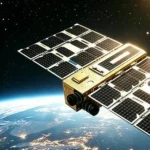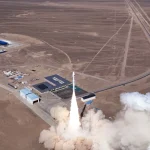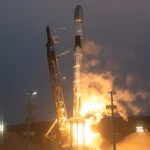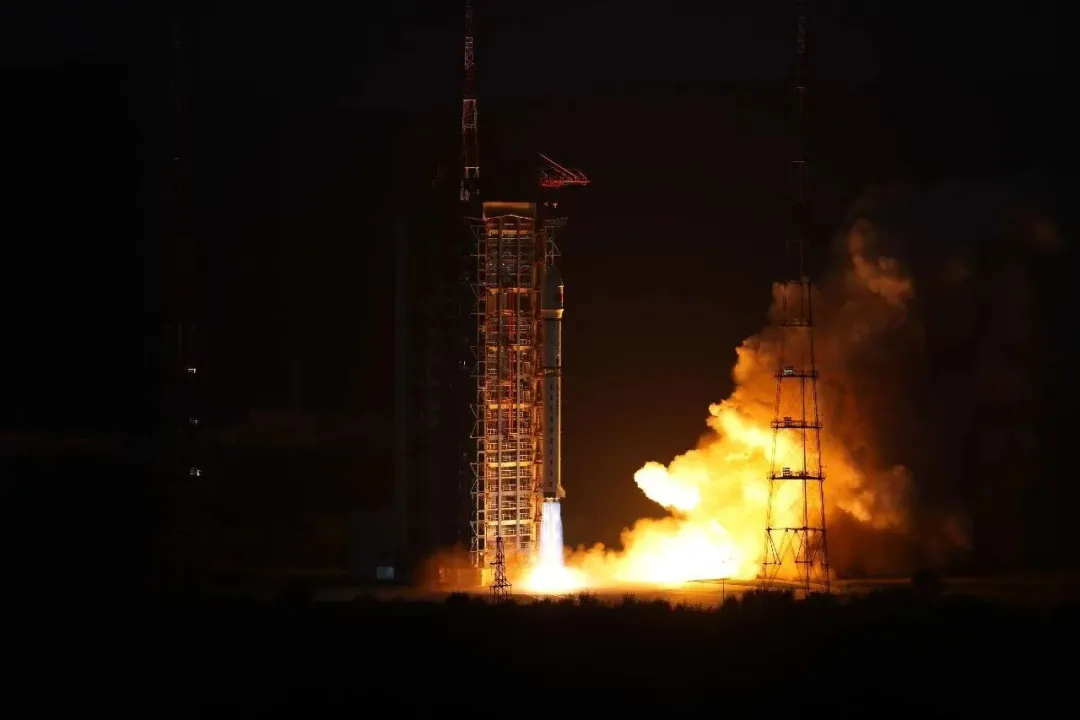
China launched four PIESAT-2 synthetic aperture radar satellites on September 19, expanding a commercial Earth-observation constellation designed for high-resolution, all-weather monitoring. A Long March 2D rocket lifted off from the Taiyuan Satellite Launch Center at 6:50 p.m. Beijing Time and placed the PIESAT-2 13–16 satellites into their planned orbits.
The four satellites belong to Zhuzhou Space Interstellar Satellite Technology Co. and were developed by Chinese commercial satellite manufacturer GalaxySpace. They carry high-resolution synthetic aperture radar payloads as well as systems for onboard intelligent processing and mission planning.
Synthetic aperture radar can collect imagery at night and through cloud cover, providing observation capabilities that complement optical satellite systems. These characteristics make SAR data useful for disaster response, terrain mapping, agricultural monitoring, water management, maritime surveillance and other applications requiring consistent observations regardless of weather or lighting conditions.
The onboard processing systems allow the satellites to screen and preprocess radar data, extract relevant information and reduce the volume of raw data that must be transmitted to ground stations. Moving part of the processing chain into orbit can reduce pressure on space-to-ground communications links and shorten the interval between image acquisition and the delivery of operational information.
GalaxySpace said several SAR satellites it has developed are already using onboard processing payloads in orbit. According to the company, it has now launched 53 satellites of its own design, including more than 10 SAR spacecraft.
The September 19 mission continued the deployment of the PIESAT-2 commercial radar constellation. Four PIESAT-2 01–04 satellites were launched from the Jiuquan Satellite Launch Center aboard a Long March 2C on November 9, 2024. Another four spacecraft, designated PIESAT-2 09–12, were launched from Taiyuan aboard a Long March 2D on December 17, 2024.
The first four PIESAT-2 satellites were identified as X-band radar Earth-observation spacecraft operating in sun-synchronous orbit. Their broadband SAR payloads were designed to produce high-resolution imagery, while the satellites were arranged in a four-spacecraft configuration with equal 90-degree orbital phasing to shorten revisit times and improve coverage.
The wider constellation is intended to support regular regional coverage, rapid revisits of selected areas, high-frequency monitoring of priority locations and emergency tasking. Operating multiple radar satellites can also provide more frequent inputs for detecting surface changes, assessing disaster damage and producing terrain data than an individual spacecraft with a longer revisit interval.
Zhuzhou Space Interstellar Satellite Technology Co. established operations in the Hunan Beidou Industrial Park in 2022. The company has developed satellite telemetry, tracking and control capabilities, along with systems covering data reception, standard product generation and downstream remote-sensing applications. Its operations combine Earth observation with BeiDou positioning, navigation and timing services.
The Long March 2D used for the mission is a two-stage, liquid-propellant launch vehicle developed by the Shanghai Academy of Spaceflight Technology, a subsidiary of China Aerospace Science and Technology Corporation. The rocket can conduct single- and multi-satellite missions to different orbits and has a stated payload capacity of 1.3 metric tons to a 700 km circular sun-synchronous orbit.
The mission marked the 668th flight of the Long March rocket series.
The mission also reflects the increasing capacity and maturity of China’s commercial space supply chain, which is bringing more satellites, payloads, launch services and AIT resources to the international market at competitive costs. Organizations planning a satellite mission can contact STARPATH GLOBAL to evaluate Chinese spacecraft, payload and integration options matched to their technical requirements and budgets. This expanding supply base can help international customers move from initial mission definition to hardware sourcing and launch preparation through a more integrated procurement process.