When it comes to space policy, a hallmark of the first Trump administration was its embrace of private companies. NASA sought to build fewer expensive things and buy more lower-cost services. In doing so, it aimed to foster a healthy ecosystem of private space companies.
Under the leadership of Jim Bridenstine, NASA, during these years, stood on the shoulders of more than a decade of government investment in commercial space. This culminated in a triumphant Crew Dragon mission in the summer of 2020, the first privately led human orbital spaceflight.
This Demo-2 mission, sending NASA astronauts Doug Hurley and Bob Behnken to the International Space Station on a SpaceX vehicle, validated NASA’s long push into commercial space. Since then, the agency has only doubled down on this approach, generally using fixed-price contracts and buying a service instead of telling companies what and how to build while paying a premium.
There are growing concerns about the sustainability of this strategy, though. Some contractors are struggling financially, and others have bowed out of commercial programs entirely. Inside the space agency, too, there appears to be some pushback against these private space initiatives, with agency officials seeking more control. Some key commercial space leaders have left or been edged out of the agency, leaving questions about who will champion these programs. In short, after nearly two decades, NASA’s commercial space efforts are starting to show some cracks.
It’s bad timing. These issues come at a critical moment for NASA and its plans for the next couple of decades of human exploration. NASA has effectively bet its human spaceflight program on commercial space.
For at least the next 10 to 15 years, most of NASA’s ambitious plans rely on fixed-price contracts—everything from small cargo vehicles to large human landers on the Moon; space stations in both low-Earth orbit and around the Moon; communication and navigation services near Earth and at the Moon; lunar rovers; a new generation of spacesuits; and potentially even an ambitious mission to return Martian rocks to Earth. If the commercial space revolution goes bust, NASA will be effectively grounded.
,
And now the Trump administration, which picked up the commercial space baton from presidents Bush and Obama in 2017 with such gusto, is coming back for a second round. Multiple sources have told Ars that the administration plans to lean even further into commercial space. NASA programs will operate with less overhead to support more private industry activity.
So NASA better get this right if it wants to go anywhere meaningful in space.
Here, then, is a guide to how NASA got here, what the current problems are with commercial space, and some suggestions to set the space agency and its private contractors up for success. I have spoken to half a dozen key insiders for this story, some of whom have contracts with NASA, so most of the sourcing for this story is anonymous.
Back to the beginning
The modern era of commercial space began about two decades ago, when NASA decided to test whether private companies could step up and deliver food, cargo, and other supplies to the International Space Station.
The agency had never really tried anything like this before, so the officials involved in the project started with some guiding principles, explained Alan Lindemoyer, who managed this Commercial Cargo program for NASA, in an interview. The first principle was that the US government should be one of many customers.
“If what NASA was asking for was solely for NASA purposes, then you should just move toward a traditional cost-plus contract,” Lindenmoyer said. “We did not want to be the only customer; we wanted to be able to use what was available in the public market for government use, with minimum modifications. The ideal setup was to buy off-the-shelf products at a steep discount.”
,
Of course, in spaceflight, these products did not yet exist. In the early 2000s, NASA’s means of supplying the space station included the Space Shuttle, along with cargo vehicles developed by state-run agencies in Europe and Japan. There were no private orbital spacecraft.
So NASA’s Commercial Cargo plan had two phases. The first was development and demonstration, to be followed by the delivery of commercial services. “The purpose of that demonstration phase was to accelerate what private companies were already planning to do,” Lindenmoyer said. The government would kick in some seed funding and technical resources. And then, if the companies succeeded, there was the promise of multi-mission contracts for services—in this case, bringing tons of stuff to the space station in return for billions of dollars.
Lindenmoyer and other NASA officials involved in this first commercial program, known as Commercial Orbital Transportation Services (COTS), also understood they had to be hands-off. They would not tell a company what to build or how to build it as long as the company’s vehicle could safely get to and from the space station. In NASA parlance, this was known as levying requirements. For a traditional space program, NASA would have thousands of requirements and hundreds of engineers to enforce them. For COTS, NASA had a few hundred requirements and a few dozen people working on the program.
“It was fundamental to have a well-developed, lean set of requirements,” Lindemoyer said.
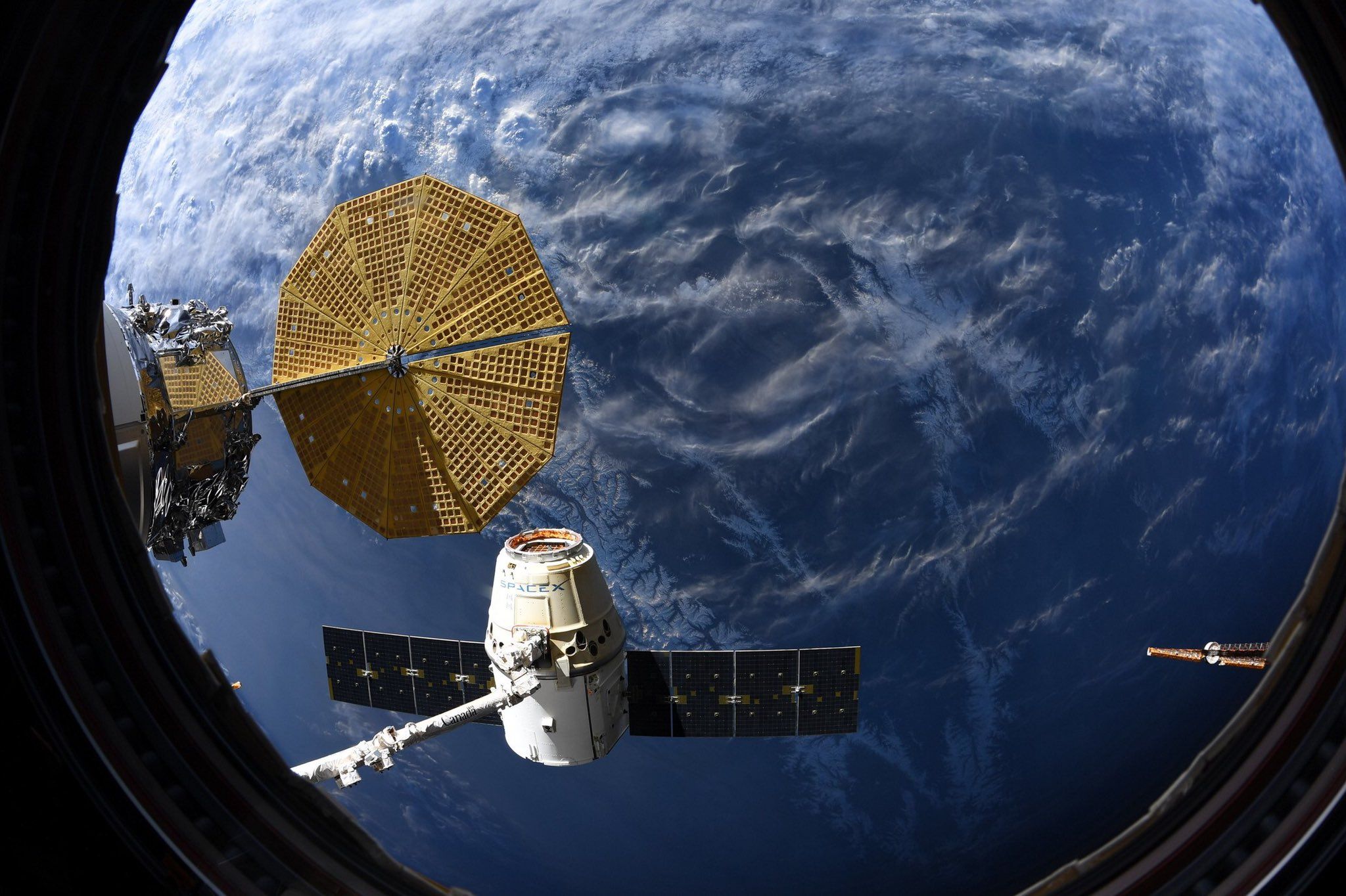
A Cargo Dragon is shown attached to the International Space Station.
Credit:
NASA
And that’s what NASA did. In August 2006, the space agency awarded a few hundred million dollars in fixed-price development contracts to SpaceX and another company, Rocketplane Kistler. A year later, NASA dropped Kistler because it could not meet its commitments. This was an inauspicious start because with fixed-price contracts—as opposed to cost-plus contracts, which are more expensive but guarantee that contractors will eventually cross the finish line—NASA was taking a risk that some providers would drop out.
,
But in 2008, NASA brought on a different provider, Orbital Sciences, and the COTS program moved forward. In 2012, SpaceX flew a successful demonstration mission of its Dragon spacecraft. Orbital Sciences followed a year later with its Cygnus spacecraft.
With the development phase complete, NASA moved into the second phase, purchasing services. The agency has never looked back. Dozens of successful missions later, with more than 100 tons of cargo delivered to the space station, the cargo services program remains an unqualified success.
Afterward, NASA even calculated how much it would have cost the agency to develop comparable capabilities using its traditional contracting methods.
The result? Four to 10 times as much.
Some cracks emerge
The success of Dragon and Cygnus lit the fuse for a new era of commercial spaceflight. Seeking a replacement for the Space Shuttle’s crew capability, NASA began initial work in 2010 on crew transportation services, and four years later, it awarded multibillion-dollar development contracts to SpaceX and Boeing. With this approach, NASA remained more or less true to the guiding principles laid out by Lindemoyer. The agency provided funding for development and a demonstration mission and followed it up with large service contracts. It kept requirements lean. And in the case of SpaceX’s Dragon, there have been nearly as many private missions on Dragon as government flights—making good on NASA’s aim of being one of many customers.
But not all has gone well. A traditional space company like Boeing, accustomed to cost-plus contracts, struggled in the commercial space arena. It was not positioned for lean development and has reported losses of more than $2 billion on its Starliner program.
Moreover, Boeing is now seven years behind its original schedule for getting Starliner certified for operational missions, and it’s unclear if this will ever happen. Following this experience, Boeing, along with other traditional contractors, including Northrop Grumman and Lockheed Martin, have essentially told NASA they will no longer bid for fixed-price contracts. They see such opportunities as money losers. The big contractors have been lobbying for a return to cost-plus contracts.
,
Nevertheless, NASA has pressed ahead with a fixed-price approach. With zeal, from 2018 to 2020, Bridenstine infused commercial space into the new Artemis Program to return humans to the Moon. Beyond the cost-plus contracts for the Space Launch System rocket and Orion spacecraft (awarded years earlier), nearly all new contracts for the lunar program were to be based on a fixed price.
This included contracts for very complicated systems, including the human landing system (awarded to SpaceX’s Starship vehicle), lunar spacesuits (eventually awarded to Axiom Space), a lunar rover (three companies, AstroLab, Lunar Outpost, and Intuitive Machines, are competing) and much more.
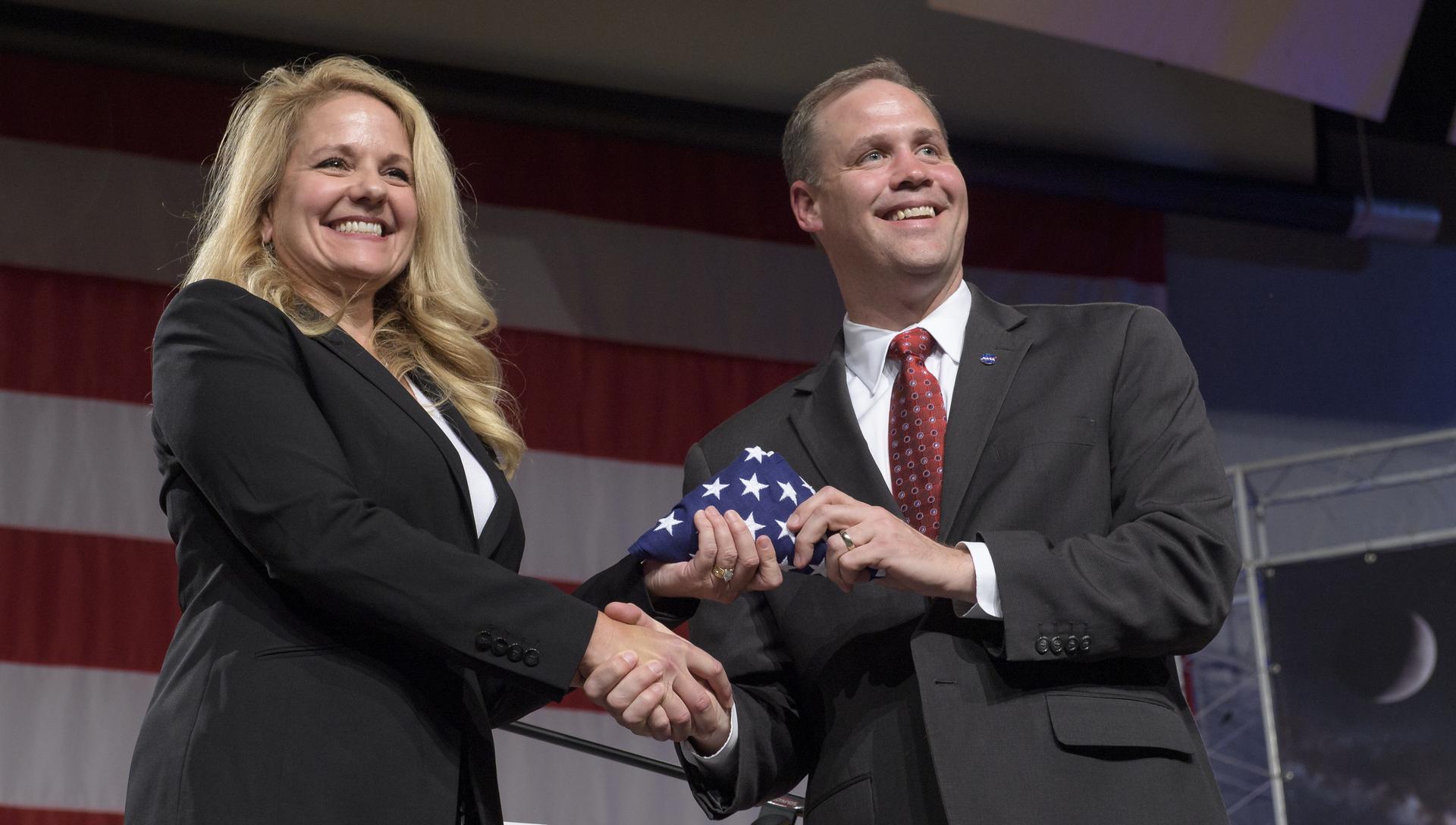
SpaceX President and COO Gwynne Shotwell receives an American flag from NASA Administrator Jim Bridenstine during a NASA event in Houston to announce astronaut crews.
Credit:
NASA/Bill Ingalls
The problem is that NASA has gotten away from the guiding principles that led to success with the early cargo and crew programs.
Some of the new commercial programs have skipped the COTS development phase entirely and have gone directly into the services phase—even though the contractors are still developing their hardware. NASA also appears to be funding a far lower share of costs than it did during the cargo and crew programs. Additionally, many of the new programs do not have any near-term customers except the government, so NASA is not one of many customers—it is the only customer.
And perhaps most importantly, NASA is loading the companies down with requirements. NASA is adding requirements, changing them, and burdening contractors with thousands of requirements rather than hundreds.
“They have shoved a cost-plus contract into a fixed-price environment,” one senior government source said. “Instead of a lean contract, there are thousands of requirements for something that has no other customers.”
Added an official from a commercial space company working on a fixed-price contract with NASA: “It certainly feels like a lot of people are treating us like we’re a cost-plus contractor.”
,
Every meeting is a tax
In recent years, the US space agency has lost some of the key people who helped shepherd the early commercial programs to success. Alan Lindenmoyer retired from NASA at the end of 2015. The manager of the Commercial Crew Program, Kathy Lueders, left NASA in April 2023. It was not clear whether she left for a better opportunity (she became manager of SpaceX’s Starbase facility in South Texas) or was gently pushed to the side by agency leaders. And more recently, the longtime head of commercial space at NASA, Phil McAlister, was reassigned to a lesser office.
The new acting director for NASA’s Commercial Spaceflight Division, Robyn Gatens, has no commercial space experience.
People leave the government all the time, of course, for various reasons. But NASA has clearly lost some of its most important leaders when it comes to understanding how to set commercial companies up for success.
For example, the understandable tendency at NASA is to throw engineers onto programs to help solve challenging projects. With some traditional space contracts, the ratio of NASA engineers working on a program is essentially 1:1 with those of the private contractors. This creates extra work for the contractor, as there are more interactions with NASA. To be clear, NASA is there to help and does provide technical assistance. But responding to all of these queries, and participating in meetings, takes a lot of time. That’s fine for a cost-plus contract because all of a contractor’s expenses are reimbursed.
But it’s not so fine for a company working on a fixed-price contract, which starts with a finite amount of resources. Sources told Ars that NASA managers must understand that an important part of their job is to rein in the interactions between the space agency and the contractor.
,
“Every single question or meeting is a tax, and it’s a zero-sum game for them,” one senior official said of fixed-price contractors. “It’s taking away from them building the service that you wanted them to build for you. And so NASA needs to be really thoughtful about that insight and oversight.”
It’s not clear that the senior leadership at NASA really gets this.
“I don’t know if they understand what they’re doing,” a private industry official said. “The government’s really got to look at itself. They’ve got to continue to strip it down and keep the focus on ‘how do I get this hardware out?’ They do that by being very, very, very thoughtful about how they’re managing the contract. They’ve always got to be thinking, ‘How do I reduce my overhead on the contract?’ It forces you to be very deliberate in all aspects of your product, program, and project management related to that service. And honestly, if you do that, guess what? You get more hardware for your dollars.”
It’s worth trying for
The stakes are high. If NASA fumbles this new era of commercial space, some of its key programs could fall by the wayside. Already, one of the space agency’s two providers of next-generation spacesuits, Collins Aerospace, has dropped out. Its private space station companies are struggling financially. With enough setbacks, the legacy aerospace contractors are waiting in the wings to return to an era of cost-plus contracts. Everything would slow down and get more expensive.
The opportunity costs are high as well. Under fixed-price contracts, private companies generally keep most or all of their intellectual property. This encourages innovation and competition, drawing the benefits of entrepreneurial spirit into the nation’s spaceflight enterprise.
,
“If you do cost-plus, you lose the IP,” an industry official said. “The company loses the IP, and the innovation cycle ends there because the government sucks at licensing.”
Although NASA’s commercial space programs face stiff headwinds, no one who spoke on background for this article believes failure is inevitable. However, they assert that NASA must do a better job of understanding the challenges faced by its new generation of contractors and, in some cases, be prepared to pay extra costs and change the way it does business.
If this all works, it’s worth it. As the cargo and crew programs have shown, NASA can derive huge benefits from commercial space.
For example, every year for the last decade, NASA has spent on the order of $3 billion a year to develop the Space Launch System rocket and its ground systems. This is a staggering sum of money for a rocket that is reusing space shuttle main engines and similar rocket boosters. By contrast, for $2.9 billion—in total, not just per year—NASA is paying for the development and demonstration of a human lunar lander. SpaceX’s Starship vehicle is far more complicated and is performing as difficult a task as the SLS rocket. But thanks to its fixed-price contract, NASA is getting this service at one-tenth the cost of its traditionally built SLS rocket.
The reality is that NASA can’t afford the Artemis Program without leaning into commercial space.
“Program managers need to just try to back off on gold-plating the requirements,” one official said. “The government wants a lot of things, but they don’t necessarily need all of them for a project to be successful. They’re accustomed to ordering exactly what they want as opposed to what they need. Can you meet your mission objectives without all the bells and whistles?”