A new generation of space infrastructure—from commercial space stations to orbital data centers and lunar systems—is driving demand for spacecraft capable of generating far more electrical power than traditional small satellites can provide. Seeking to address that challenge, Beyond Reach Technologies has introduced FlareWing, a family of deployable structural systems designed to dramatically increase the amount of solar power that can be carried by compact spacecraft.
The company announced the FlareWing product line on Aug. 24, unveiling rigid deployable structures that can support large solar arrays while remaining compact enough to fit within modern launch vehicle constraints. The technology is intended to enable small and medium-sized satellites to achieve power levels previously associated with much larger spacecraft.
From Compact Launch Package to Hundreds of Kilowatts in Orbit
FlareWing is being offered in three configurations, ranging from systems suitable for high-performance small satellites to structures capable of supporting power-hungry orbital platforms.
The smallest variant, FlareWing-S, stows within a volume measuring approximately 1 meter by 0.25 meters by 0.08 meters. Once deployed, it can provide roughly 30 square meters of surface area for solar panels, generating between 5 and 8 kilowatts of power depending on solar-cell selection.
At the opposite end of the lineup, FlareWing-L can be packaged into a structure measuring about 6 meters by 0.29 meters by 0.13 meters for launch but expands to approximately 625 square meters of usable area. According to the company, the largest configuration could support power generation of up to 200 kilowatts.
The intermediate FlareWing-M model is designed to bridge the gap between those two extremes, targeting spacecraft that require tens of kilowatts of power.
The company expects FlareWing-S to complete ground qualification by the end of 2026, with customer spacecraft integration beginning in early 2027. FlareWing-M is scheduled to reach ground qualification during the second quarter of 2027, while qualification of FlareWing-L is targeted before the end of next year.
NASA Research Origins Shaped the Technology
The roots of the technology trace back to a NASA Innovative Advanced Concepts (NIAC) study conducted by Beyond Reach co-founder and chief executive Mitchell Fogelson during his graduate research at Carnegie Mellon University.
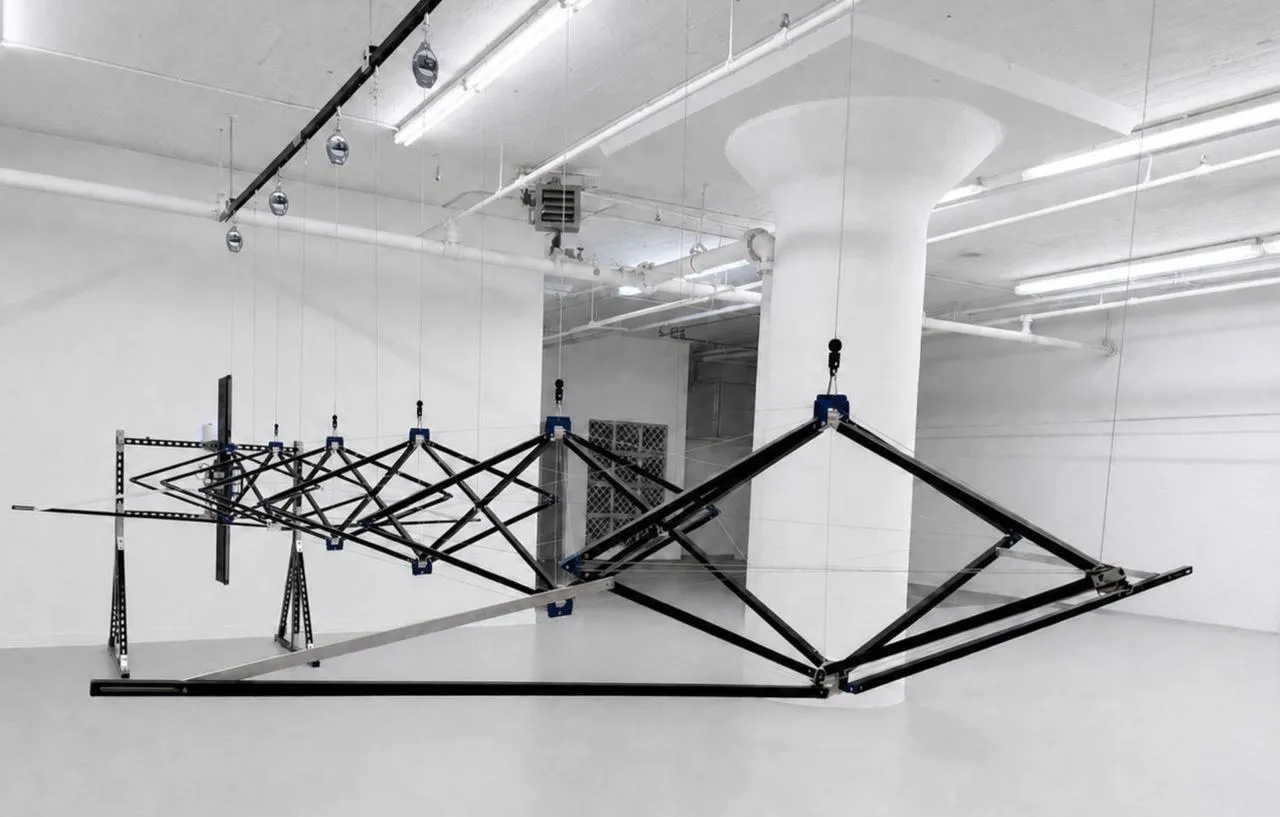
That research examined methods for deploying structures on kilometer scales from a single launch vehicle. The work eventually led to development of the deployable truss architecture that forms the basis of FlareWing.
Unlike many conventional deployable systems, the Beyond Reach design stores flat for launch and expands into a triangular truss configuration after deployment. According to the company, a key advantage is that structural stiffness increases as the system extends, helping reduce vibrations and bending modes that can interfere with spacecraft attitude control, pointing accuracy, and maneuvering performance.
Structural rigidity is becoming increasingly important as satellites support larger antennas, more capable sensors, higher-power communications systems, and expanded solar arrays. Large flexible structures can create control challenges that require additional mass and complexity to manage.
Why Spacecraft Need More Power Than Ever Before
For decades, many commercial satellites operated comfortably within power budgets measured in hundreds of watts or a few kilowatts. That landscape is changing rapidly.
Artificial intelligence processing in orbit, direct-to-device communications networks, advanced Earth-observation payloads, space-based manufacturing facilities, commercial space stations, and future lunar infrastructure are all increasing spacecraft energy requirements.
Power availability is emerging as one of the most important constraints on next-generation mission design. A satellite may possess sufficient communications bandwidth, computing capability, or payload capacity, yet still be limited by the amount of electrical power it can generate and distribute.
The challenge is fundamentally linked to launch economics and spacecraft packaging. Solar arrays generate more electricity as their surface area grows, but rockets impose strict volume constraints. Engineers therefore face a constant tradeoff between launch packaging efficiency and operational capability once in orbit.
Beyond Reach is attempting to shift that balance by enabling much larger deployed structures without requiring proportionally larger launch volumes.
Deployable Structures Have Become a Strategic SmallSat Technology
Deployable systems have long been recognized as one of the most important enabling technologies for small spacecraft.
Modern deployable architectures are used for solar arrays, antennas, radiators, drag sails, gravity-gradient booms, and scientific instruments. NASA and other organizations have spent years developing compact deployable mechanisms capable of expanding into much larger operational configurations after launch.
The small-satellite sector increasingly relies on such systems because spacecraft dimensions are often dictated by launch adapters and rideshare opportunities rather than mission requirements. Deployable structures allow operators to launch compact spacecraft while still obtaining the performance benefits of larger systems once in orbit.
Historically, however, scaling deployable structures has introduced new challenges. Larger arrays often become more flexible, increasing vibration and structural dynamics concerns. Maintaining stiffness while minimizing mass remains one of the most difficult engineering problems in deployable-spacecraft design.
This is the area where Beyond Reach believes its architecture offers a competitive advantage.
Designed for the Starship Era
The FlareWing concept also reflects broader changes occurring in launch vehicle design.
SpaceX’s Starship system is expected to reshape how spacecraft are packaged and deployed. Instead of designing satellites around traditional cylindrical fairings, manufacturers are increasingly considering flatter and more elongated spacecraft geometries optimized for Starship’s payload volume and deployment architecture.
Beyond Reach executives have indicated that future spacecraft may increasingly resemble the form factors used in the Starlink constellation rather than traditional box-shaped satellite buses.
If that transition occurs across the industry, deployable power-generation systems could become even more important. Operators will seek to maximize payload density within launch vehicles while preserving operational performance after deployment.
The ability to package large amounts of power-generation capability into narrow, flat structures could therefore become a valuable differentiator for spacecraft manufacturers targeting large constellation deployments and emerging orbital infrastructure markets.
Competition in the Race for High-Power Space Infrastructure
Beyond Reach is entering a growing market focused on enabling high-power spacecraft.
A range of companies and government programs are developing advanced solar arrays, deployable booms, lightweight structural systems, and thermal-management technologies intended to support increasingly ambitious missions. NASA has pursued deployable composite boom technologies for small satellites, while multiple commercial firms are developing high-power solar-array solutions for satellites, stations, and lunar applications.
What distinguishes many new entrants is the focus on scaling beyond traditional satellite requirements. Rather than targeting incremental improvements, companies are increasingly designing systems capable of supporting tens or hundreds of kilowatts of power generation.
That trend aligns with broader industry forecasts that envision orbital computing facilities, commercial habitats, in-space manufacturing platforms, and other large-scale infrastructure requiring substantially more energy than today’s spacecraft.
Building Toward Larger Orbital Megastructures
Although FlareWing is initially positioned as a deployable solar-array support structure, the underlying technology has implications beyond power generation.
Large deployable truss systems could eventually support thermal radiators, communications platforms, space telescopes, artificial-gravity habitats, and other large-scale orbital systems that are difficult or impossible to launch in fully assembled form.
The company’s long-term vision centers on enabling space structures that can expand from compact launch configurations into systems spanning hundreds of meters or even kilometers.
Whether those ambitions materialize will depend on successful qualification testing, flight demonstrations, and customer adoption over the next several years. However, the unveiling of FlareWing highlights a growing reality within the space industry: as missions demand more power, computing capability, and operational complexity, deployable structures are becoming just as important as launch vehicles themselves.
Conclusion
Beyond Reach’s FlareWing family represents an effort to address one of the most pressing engineering challenges facing next-generation spacecraft: delivering significantly more power without sacrificing launch efficiency. By combining compact stowage with large deployed surface areas and an emphasis on structural stiffness, the company aims to enable a new class of high-power satellites and orbital infrastructure. As commercial space stations, orbital data centers, and lunar systems move from concept to reality, technologies that unlock greater power generation could become foundational components of the emerging space economy.