Aerospace startup CesiumAstro said on Monday it has raised $470 million to finance manufacturing expansion and product development as demand grows for components used in low-Earth orbit satellite constellations.
More than half of the funding came from an equity round led by Trousdale Ventures, with participation from Airbus Ventures, the Development Bank of Japan, and other investors. The remaining $200 million was raised through debt financing provided by the Export-Import Bank of the United States and J.P. Morgan, the company said.
CesiumAstro supplies hardware for low-Earth orbit satellite systems, a market attracting investment from companies such as SpaceX, Amazon, and Blue Origin. Technology firms are also entering the segment, with Google announcing plans last year to launch satellites aimed at running artificial intelligence workloads in space.
The company’s product portfolio includes satellite computing and communications components. Its RDP-23FV chip integrates multiple processors based on Arm Holdings designs along with 7 gigabytes of memory, which CesiumAstro says includes features to automatically correct certain data errors. The chip can be embedded in satellites to run onboard software.
CesiumAstro also produces the RPU, a chip used to manage satellite communications antennas. The device incorporates an oscillator that helps set transmission frequencies and supports beamforming, a technique that concentrates radio signals in a specific direction to improve signal strength.
Beyond signal management, the company offers signal generation hardware, including a software-defined radio known as the SDR-2104. The module can be deployed in low-Earth orbit satellites, lunar rovers and deep-space spacecraft and includes a field-programmable gate array that enables onboard AI processing.
For end users, CesiumAstro sells a connectivity terminal called Skylark, which uses an active phased array of flat antennas with no moving parts. The company says the device can be installed on vehicles, ships and aircraft to provide broadband connectivity.
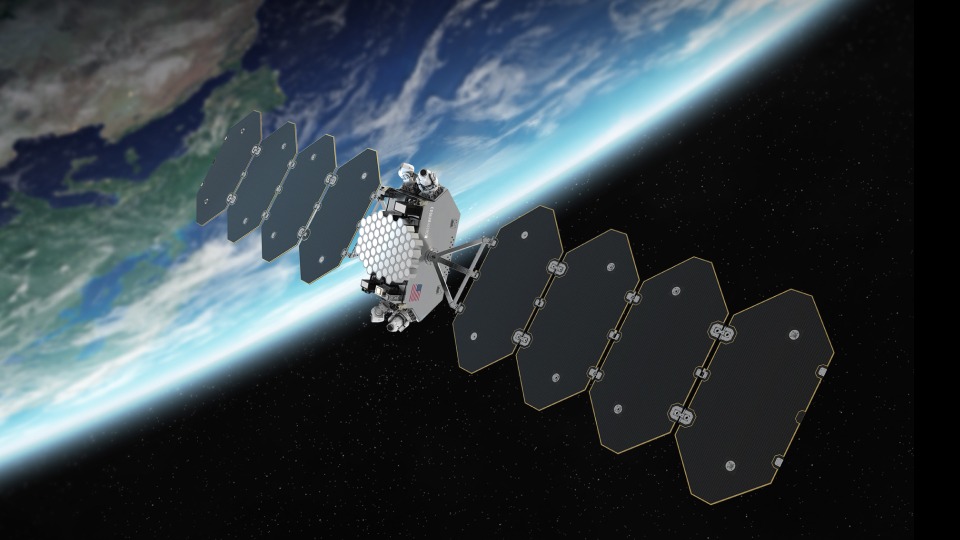
CesiumAstro also markets a complete satellite platform, Element, which integrates antennas, propulsion and interference-filtering features and is designed to operate for up to five years at altitudes between about 310 and 635 miles.
The company said part of the new funding will be used to accelerate production of Element satellites, with plans to launch more than half a dozen units in the coming years. CesiumAstro also plans to build a new 270,000-square-foot headquarters and further develop its satellite networking technologies.