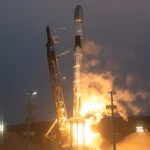
NASA selected SpaceX on September 18 to launch StarBurst, a small astrophysics satellite designed to detect short gamma-ray bursts associated with neutron star mergers. The spacecraft will fly no earlier than 2028 as a rideshare payload on a Falcon 9 Bandwagon mission from Space Launch Complex 40 at Cape Canaveral Space Force Station in Florida.
The launch assignment is a firm-fixed-price task order issued through NASA’s Venture-Class Acquisition of Dedicated and Rideshare contract, known as VADR. Managed by the agency’s Launch Services Program at Kennedy Space Center, VADR allows NASA to purchase dedicated launches and rideshare opportunities for smaller missions during a 10-year ordering period.
The indefinite-delivery, indefinite-quantity contract has a maximum aggregate value of $1 billion across all participating launch providers. NASA uses the arrangement to match relatively small spacecraft with lower-cost launch options instead of purchasing an entire rocket for each mission.
SpaceX’s Bandwagon program provides shared Falcon 9 launches to mid-inclination orbits, complementing the company’s Transporter rideshare missions, which primarily target sun-synchronous orbit. StarBurst’s selection illustrates how standardized commercial rideshares are increasingly being used for astrophysics as well as Earth observation and technology demonstrations.
StarBurst is one of the missions developed under NASA’s Astrophysics Pioneers Program, which supports lower-cost investigations conducted with small satellites, balloon payloads and other compact platforms. The program is intended to shorten development cycles and expand flight opportunities for focused science missions that do not require a large observatory.
The spacecraft will monitor nearly the entire sky not obscured by Earth for short gamma-ray bursts, extremely energetic flashes that typically last less than two seconds. These events are believed to originate primarily from mergers involving neutron stars, the dense remnants left after massive stars explode.
StarBurst is designed to detect the first high-energy emission from those mergers. Its wide field of view will increase the probability of observing an event at the same time as ground-based gravitational-wave facilities, enabling researchers to compare electromagnetic radiation with distortions in spacetime produced by the same collision.
That combination is known as multimessenger astronomy. Gamma rays can reveal the timing, energy and direction of the initial explosion, while gravitational-wave measurements provide information about the masses, motion and structure of the merging objects. Follow-up observations at X-ray, ultraviolet, optical, infrared and radio wavelengths can then track the evolution of the resulting jet and expanding debris.
Joint observations may help researchers investigate how short gamma-ray bursts generate relativistic jets, what objects remain after neutron stars merge and how such collisions produce heavy elements. They can also improve constraints on the equation of state of neutron-star matter, which describes how material behaves at densities that cannot be reproduced in terrestrial laboratories.
The mission follows the first confirmed joint detection of gravitational waves and a short gamma-ray burst in August 2017. That event, designated GW170817, demonstrated that neutron star mergers produce both types of signal and established a new method for studying compact-object collisions. However, such coordinated detections remain rare, making broad and continuous gamma-ray coverage important for future observing campaigns.
NASA’s selection of a scheduled rideshare reduces the launch burden for StarBurst but also ties deployment to the broader Bandwagon mission manifest. The spacecraft must be integrated alongside other payloads and meet the shared mission’s mass, interface, safety and orbital requirements.
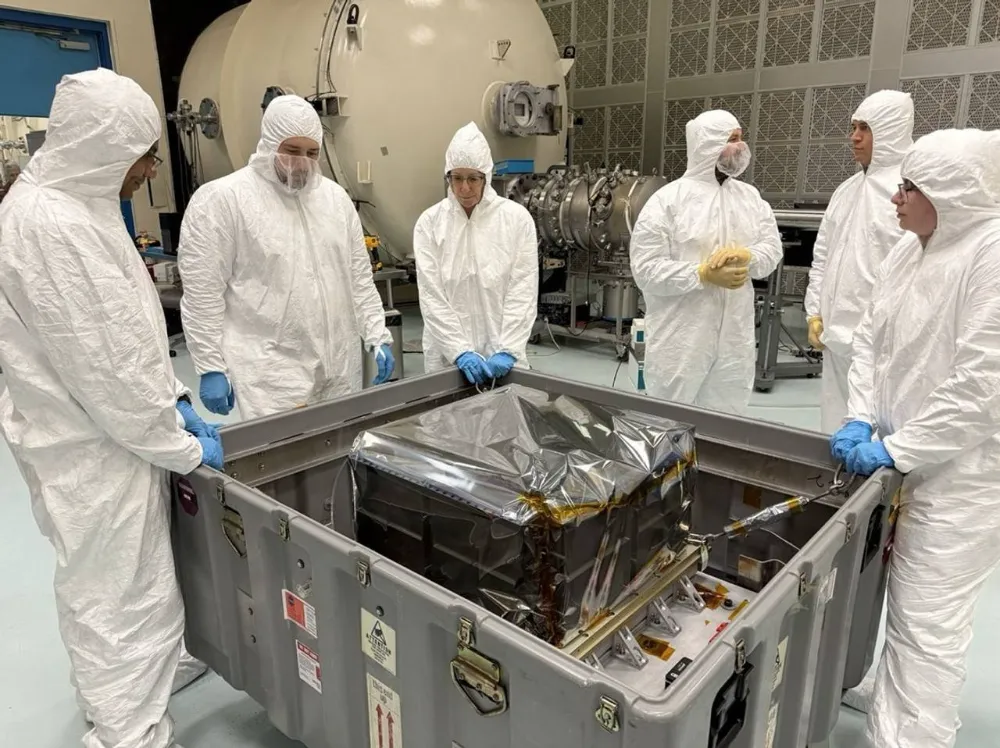
StarBurst’s next major steps will include completing spacecraft and instrument development, environmental qualification and launch integration ahead of the no-earlier-than-2028 flight. Once in orbit, the mission will work with gravitational-wave observatories and other telescopes to identify neutron star mergers through multiple signals and provide rapid observations of some of the universe’s most energetic transient events.