Sophia Space and aerospace leasing specialist SLI have outlined a $300 million asset-financing framework for a planned 10-satellite edge computing constellation, the companies announced September 13. The non-binding arrangement would fund spacecraft construction and deployment against defined milestones, with launches beginning as early as 2028.
The proposed structure adapts operating leases widely used for aircraft, ships and other capital-intensive infrastructure to commercial satellites. SLI would purchase the spacecraft from Sophia Space, retain ownership and lease them directly to end users for fixed monthly or quarterly payments.
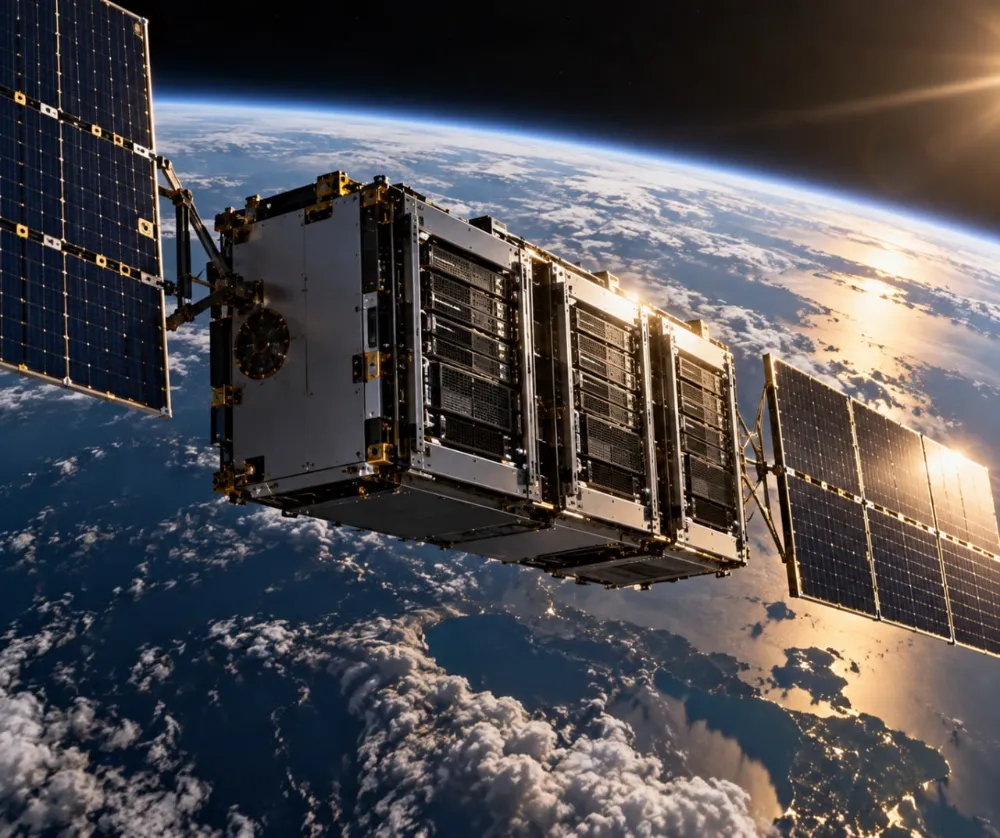
Sophia Space would build the satellites around its TILE, or Thermal Integrated LEO Edge, computing architecture. The full constellation is designed to provide aggregate processing capacity equivalent to 240 state-of-the-art edge servers, according to the company.
SLI would release financing as Sophia meets development, manufacturing and launch milestones. Ownership would transfer to SLI following in-orbit acceptance, including verification that the deployed network meets previously agreed performance standards. The satellites would then operate under long-term leases intended to cover their expected useful lives.
Operational control would remain with Sophia Space and its customers, which would determine how responsibility for individual spacecraft and computing services is divided.
Leasing Model Shifts Customer Spending to Operations
The structure is intended to convert the acquisition of orbital computing capacity from a large upfront capital expenditure into a recurring operating expense. Instead of buying a satellite, a customer could lease an asset configured for its processing requirements while avoiding much of the initial financing burden.
For Sophia Space, the arrangement would provide access to non-dilutive capital and preserve equity funding for technology development, integration and operations. It could also give prospective customers a more familiar payment structure for adopting an emerging class of space infrastructure.
The agreement remains subject to significant conditions. It is currently documented through a non-binding letter of support rather than definitive financing contracts, and Sophia Space CEO and cofounder Rob DeMillo said the framework will convert only after the company closes its final financing round.
Sophia Space has raised $22 million to date, including a $10 million seed round announced in February and a $7 million Simple Agreement for Future Equity financing completed in June. Under a SAFE agreement, investors provide capital in exchange for the right to receive equity following a future financing event.
No customers have committed to leases under the SLI framework. Sophia Space is responsible for securing those users, although DeMillo said the company has an active customer pipeline.
That distinction makes the $300 million figure a potential financing capacity rather than capital that has already been fully committed and disbursed. Deployment will depend on Sophia completing its fundraising, converting the framework into binding agreements, meeting technical milestones and signing customers.
TILE Constellation Follows Planned 2027 Demonstration
Each of the 10 satellites covered by the framework is expected to carry six TILE modules, with four Nvidia Jetson processors integrated into each module. That configuration would place 24 processing units on each spacecraft and 240 across the constellation.
Sophia’s modular architecture integrates electrical power, computing and thermal management into flat, passively cooled assemblies. Thermal control is a central challenge for orbital computing because high-performance processors generate substantial heat, while spacecraft in vacuum cannot use atmospheric convection for cooling. TILE is designed to conduct heat from the processors to radiating surfaces without relying on conventional terrestrial cooling equipment.
Processing data close to where it is generated could reduce the volume that satellites must transmit to ground stations. Earth observation, weather, disaster-response and intelligence missions can use onboard computing to filter imagery, identify relevant events or compress data before transmission, reducing downlink demand and shortening the time between collection and delivery of actionable information.
Sophia Space is separately preparing the Athena in-orbit demonstration of TILE technology for the fourth quarter of 2027. The mission is expected to use an Apex Space Nova satellite platform, while Netherlands-based Spherical is supplying a flight-qualified electrical power system and battery architecture. Athena is not part of the 10-spacecraft financing facility but is intended to demonstrate key technology before the larger deployment begins.
SLI, established by Libra Group in 2023, is extending an asset-leasing strategy that has progressed from ground infrastructure toward spacecraft. The company previously acquired an Arctic ground station and 10 antennas from Microsoft for lease to RBC Signals. In December 2025, it also signed a non-binding agreement covering the acquisition of two geostationary satellites valued at more than $200 million for lease to operators.
Libra Group brings more than $15 billion in asset-financing experience across transportation industries, according to the companies. Applying that model to satellites could broaden the capital available for commercial constellations, but lessors must also manage risks uncommon in aviation or shipping, including launch failure, limited physical access after deployment, rapid technology obsolescence and uncertain residual value.
Sophia’s next steps are to close its remaining financing round, negotiate definitive agreements with SLI, secure lease customers and complete the Athena flight demonstration before the first constellation launch targeted for 2028.