In 2026, space-based computing emerged as a major new direction for the commercial space industry. What problems is it meant to solve, and where is the industry heading? Hello Space has launched the Space-Based Computing Interview Series, speaking with leading Chinese companies to examine the real progress being made in this emerging field.
Our guest for this interview is Qin Jing, Chairwoman of Xiopm SPACE.
Interview Highlights
- Traditional remote sensing follows a “sense in space, compute on Earth” model. Hyperspectral intelligent computing aims to achieve true “sense and compute in space,” giving satellites a brain and data a fingerprint.
- The value of space-based computing does not lie in simply moving terrestrial computing resources into space. It lies in filtering for high-value information in orbit, reducing the transmission of massive volumes of useless data, and enabling satellites to evolve from “taking pictures” to “processing data autonomously and delivering results.”
- The goal of commercial remote sensing is to progress from selling data to selling products and ultimately to selling services.
- At the heart of our work in space-based intelligent computing is an industry-wide transition from “acquiring data in space and processing it on Earth” to “processing data in space and receiving the results on Earth.”
- Good technology does not necessarily make a good product, and a good product does not necessarily make a good business model. Simply piling on computing power without considering actual use cases will only leave capacity idle and drive up costs.
- The biggest misconception in the space-based computing industry is the pursuit of ever-higher TOPS figures without regard for applications. Computing power without industry-specific models or real-world use cases is merely an empty metric that raises costs and leaves resources underutilized.
- What space-based computing should really pursue is balanced computing capacity matched to specific business applications.
On July 22, 2026, Xiopm SPACE launched China’s first quantitative hyperspectral intelligent computing satellite, beginning in-orbit verification of quantitative processing and intelligent analysis of hyperspectral data. As space-based computing moves from concept to engineering practice, how does a space company with a genuine need for computing in orbit turn it into real commercial value rather than a superficial showcase?

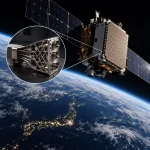
Xiguang-2 01 (Caiyun Hyperspectral-01) undergoing testing
As China’s first commercial hyperspectral satellite to use an interferometric spectral imaging system, it acquires and processes remote sensing data and makes decisions directly in orbit, marking a historic transition to “data acquisition and computing in space” for hyperspectral remote sensing.
The company’s focus on hyperspectral remote sensing provides a representative case for examining the commercial value of space-based computing. By integrating imagery and spectral data, hyperspectral remote sensing can identify the composition and condition of materials through their spectral signatures. It has practical applications in mineral exploration, environmental monitoring, agriculture and other fields. Yet the enormous volume of hyperspectral data has long constrained its commercial adoption—and this is precisely where space-based computing has found an opportunity.
Capturing vast quantities of hyperspectral imagery is easy; transmitting it to Earth is not. A single hyperspectral scene can exceed 1 GB. During continuous Earth observation, transmitting the data to a ground station can take far longer than capturing it. Large quantities of low-value imagery obscured by clouds or other interference also consume scarce transmission bandwidth.
Onboard intelligent computing can filter out low-value data directly in orbit, preprocess raw data streams and transmit only information with commercial value. This can reduce the time required to obtain useful information from hundreds of minutes to mere seconds, improving overall efficiency by nearly 10,000 times. In other words, space-based computing extracts high-value information from vast volumes of raw data before it enters the bandwidth-constrained space-to-ground link.
Ultimately, however, greater link efficiency must serve customers’ actual needs. Users in mining, carbon management, agriculture and other industries do not care about satellite specifications, data-downlink latency or complicated processing workflows. They care about the accuracy of the result and the return on their investment. Put simply, customers want answers. The value of space-based computing lies in enabling remote sensing services to progress from selling data to delivering standardized products and, ultimately, ready-to-use industry services.
Xiopm SPACE also stresses that computing capacity in orbit alone is far from sufficient. Simply increasing onboard computing power or competing over TOPS figures, without industry models or scenario-based validation, will leave computing capacity idle and create no practical value. Hyperspectral observations are three-dimensional image-spectrum data, and general-purpose remote sensing AI models cannot uncover the material information embedded in spectral fingerprints. Dedicated hyperspectral AI foundation models are therefore needed. These models must be trained on large quantities of high-quality spectral samples and continuously updated through coordinated space-ground operations.
Only by combining computing hardware in orbit with the corresponding software models can a complete capability be created.
Judging from current industry practice, remote sensing—and hyperspectral remote sensing in particular—is among the applications most likely to establish an early commercial closed loop for space-based computing. It addresses clearly defined industry pain points, delivers quantifiable benefits and serves customers in energy, mining, carbon management and precision agriculture that are willing to pay for results.
Demand, however, does not mean that a commercial closed loop has already been established. Xiopm SPACE’s onboard intelligent computing capability is still moving from in-orbit verification toward commercial application.
The company’s hyperspectral intelligent computing project demonstrates why space-based computing and the “sense and compute in space” model are needed. When the enormous volumes of data collected by satellites cannot all be transmitted to Earth, computing evolves from a means of increasing processing capacity into infrastructure that filters information and directly generates results.
The following is an edited transcript of Hello Space’s interview with Qin Jing, Chairwoman of Xiopm SPACE. Some responses have been organized and edited for readability.
Why Does Hyperspectral Remote Sensing Need Space-Based Computing?
Hello Space: Xiopm SPACE focuses on hyperspectral remote sensing. Why did the company choose hyperspectral technology as its entry point into commercial space?
Qin Jing: Xiopm SPACE chose hyperspectral technology as its entry point for two reasons.
First, there is a gap in the market. Commercial remote sensing currently focuses mainly on visible-light and synthetic aperture radar satellites. Hyperspectral systems remain relatively scarce, giving the segment substantial market potential.
Hyperspectral remote sensing integrates imagery and spectral data. It is comparable to performing a CT scan of the Earth’s surface. Ordinary visible-light remote sensing can reveal the location and area of surface features, while hyperspectral remote sensing can identify material composition through spectral fingerprints.
Second, we have a strong technological foundation. The company originated from a research institute, where hyperspectral technology has long been a core discipline. We have accumulated mature technologies in this field, making it easier to establish barriers to entry.
Hello Space: In other words, relatively few companies are working in this field, competition is less intense and the technology is scarce. Xiopm SPACE also benefits from the research institute’s technical expertise and from the distinctive advantages of hyperspectral remote sensing over conventional visible-light remote sensing. How have those advantages translated into commercial applications?
Qin Jing: The core value of hyperspectral technology does not lie in the spatial-resolution imagery associated with traditional remote sensing. It lies in its unique spectral capabilities, which combine spatial and spectral information.
Traditional optical remote sensing relies on images. It uses color, texture and shape to identify surface-level information such as roads, building areas and farmland.
Hyperspectral remote sensing adds a spectral dimension. Every pixel has a spectral curve unique to the material it represents. In addition to performing the functions of conventional remote sensing, it can identify the composition, concentration, condition and changes of surface materials, revealing deeper information invisible to the human eye.
In agriculture, conventional optical systems can identify the area of farmland and assess the surface appearance of crop growth. Hyperspectral systems can accurately monitor soil properties, moisture, nitrogen, phosphorus and potassium levels, crop chlorophyll content, and changes in crop growth following fertilization.
In ecological monitoring and carbon management, our hyperspectral satellites can retrieve changes in methane and carbon dioxide concentrations that are invisible to the naked eye. Using a high-resolution interferometric system, they can precisely monitor carbon sources, carbon sinks, emissions and absorption. They can also analyze methane emissions from companies in the power, energy, chemical and coal industries. These are commercial advantages unique to hyperspectral satellites.
Hello Space: Hyperspectral technology clearly has some distinctive capabilities and advantages. Why, then, did it fail to achieve large-scale commercialization in the past? What has changed today that makes industrial-scale adoption possible?
Qin Jing: There were several major obstacles to the large-scale commercialization of hyperspectral remote sensing.
First, hyperspectral data is difficult to process. Unlike ordinary two-dimensional imagery, it requires complicated calibration, inversion, analysis and identification. There are also cases in which the same material displays different spectral characteristics, or different materials display similar spectra. These issues have limited accuracy in industry applications.
Second, the industry has had relatively few professionals, resulting in insufficient application experience and limited accumulated expertise.
Third, hyperspectral data volumes are enormous. Conventional space-to-ground transmission and ground-based analysis are slow, resulting in low application efficiency.
Fourth, the industry lacked mature commercialization models. Good technologies were not successfully converted into products that customers would pay for or into tangible business value.
Conditions are now becoming more favorable. As the industry develops, more professionals are entering the field and application experience continues to accumulate. At the same time, onboard intelligent computing is transforming a workflow previously completed entirely on Earth into one in which data is processed in space and then transmitted to Earth. This significantly improves the timeliness of data applications.
As a commercial space company, we identify rigid industry demand and specific pain points, then build practical benchmark projects for which customers are willing to pay. These projects allow us to establish and expand profitable commercialization models for hyperspectral remote sensing and advance its industrialization at scale.
What Problems Does Space-Based Computing Solve for Hyperspectral Remote Sensing?
Hello Space: Much of this appears to involve filtering valuable information before transmitting it. Which hyperspectral data must be downlinked, and which data does not need to be transmitted? How much hyperspectral data processing can currently be performed in orbit?
Qin Jing: First, optical imaging is easily affected by weather. Cloud cover can produce low-value imagery, which needs to be identified and filtered out automatically.
Second, we have worked with Zhejiang Lab to develop onboard computing capabilities that can process raw data streams into Level 2A or even higher-level imagery. The data transmitted to Earth can therefore have direct commercial value.
For these two reasons, deploying onboard intelligent computing for hyperspectral remote sensing is essential.
Hello Space: Which applications do you believe can benefit most from computing in space? How does your view differ from what others in the industry are proposing?
Qin Jing: The development of space-based computing will proceed in several stages.
The first step is to build intelligent remote sensing satellites capable of computing in space, improving the overall efficiency of data processing and transmission by nearly 10,000 times.
The second step will come with the development of large constellations. We will gradually deploy inter-satellite and space-ground computing capabilities, establish inter-satellite networks and match computing resources to demand. When many satellites collect large quantities of data, computing involves power consumption and energy allocation across what can be understood as a network.
Only in the third stage will terrestrial computing units gradually be moved into space to save electricity, conserve energy and reduce overall energy consumption.
The technology must progress through these stages. We should first accomplish objectives that can be implemented today and generate commercial value. Once our capabilities improve, we can create the next source of commercially valuable demand.
Computing in space is not some distant prospect. It already has commercial value today. We do not want people to believe that practical applications remain far away.
What Customer Problems Does Space-Based Computing Solve?
Hello Space: You have repeatedly discussed improving the hyperspectral intelligent computing constellation. Hyperspectral data volumes are enormous and require considerable processing capacity. Will onboard computing be used only for data processing? At the application level, will customers receive results already processed in orbit, or will raw data still be transmitted to Earth for interpretation?
Qin Jing: The conventional processing model can still meet the current timeliness requirements of many industries. But when hyperspectral satellites image continuously, they generate enormous amounts of data and encounter a severe downlink bottleneck.
Onboard intelligent computing solves the challenge of transmitting hyperspectral big data. It improves transmission efficiency, enables more useful information to reach Earth and increases the value of the data collected by the satellite.
Hello Space: After screening in orbit, will the satellite still transmit hyperspectral imagery? Do customers want raw imagery, or do they want the final analytical results?
Qin Jing: Industry customers want the final results.
Hyperspectral satellites combine spatial and spectral information. Compared with conventional optical remote sensing, the data requires additional processes—including atmospheric and radiometric correction, noise reduction, calibration and mixed-pixel decomposition—to ensure the accuracy of three-dimensional spectral information. Processing is therefore more difficult.
We need to develop models, train them on data, evaluate their performance and conduct ground verification. Only through end-to-end training with massive datasets can we produce accurate and useful information.
Our work covers two main dimensions. The first is hardware: we place computing resources aboard the satellite so that it can process data intelligently. The second is software: we use massive volumes of ground-based data to train foundation models, which are then deployed on the satellite’s computing system to generate accurate results.
This combination of hardware and software is also why hyperspectral remote sensing is more difficult than conventional remote sensing. We have already established capabilities on both fronts.
Computing Power Alone Is Not Enough
Hello Space: Many organizations are developing remote sensing AI models. Why does Xiopm SPACE need to develop a separate hyperspectral remote sensing model? What are the limitations of general-purpose remote sensing models and models developed by other service providers?
Qin Jing: Customers want final results. They do not care about satellite specifications or the difficulty of processing the data. They care about the accuracy of the results and the return on investment.
Mining customers, for example, want to know the location and area of an ore body and the accuracy of the assessment. Agricultural customers need information on crop growth, pests and diseases. Commercial space-based remote sensing is evolving from selling data to selling products and services. The objective is to deliver analytical results that customers can use directly in commercial operations.
Hyperspectral observations are three-dimensional data, unlike the two-dimensional data produced by conventional optical and SAR systems. They cannot simply be fed into general-purpose remote sensing models.
We train dedicated hyperspectral models using data from five major application areas: agriculture, forestry, mining, water and carbon management. Only these models can extract information unavailable through conventional remote sensing. This does not mean that other models have no value. It means we must independently develop specialized models adapted to hyperspectral data.
Hello Space: From that perspective, will the central competitive barrier for future hyperspectral AI foundation models be access to proprietary, high-quality hyperspectral data? Will the companies with more such data be able to build better models?
Qin Jing: There are two dimensions to the barrier, and you are correct about the first.
On the one hand, companies need massive quantities of high-quality data. On the other, they need the computing capacity to use it. Owning data without having the ability to extract its value makes that value difficult to realize.
This is why we began deploying intelligent computing satellites at an early stage. Our approach differs from general-purpose computing. Our objective is to use onboard intelligent computing to mine remote sensing data in depth and directly produce analytical results.
Remote Sensing Could Become the First Commercial Market for Space-Based Computing
Hello Space: Xiopm SPACE is planning the Xiguang Series constellation. How did the company determine the number of satellites? Was the calculation based on global coverage, deployment timelines, the number of target areas, business demand or cost?
Qin Jing: The Xiguang Series is divided into three types of constellation based on the three fields we identified when the company was founded: conventional general-purpose hyperspectral remote sensing, hyperspectral monitoring for carbon management, and ultra-high-performance specialized hyperspectral remote sensing.
The combined number of satellites across these three constellations has been refined continuously since the company’s founding, based on the characteristics of hyperspectral remote sensing, our understanding of the industry and our forecasts for the commercial market.
As computing capabilities and temporal resolution improve, we may establish even larger constellations in the future. But we will increase satellite investment only as the business model becomes clearer, customers demonstrate a greater willingness to pay and commercial returns improve.
Hello Space: Will the planned Xiguang Series constellation use inter-satellite communications to share computing resources and data, or will each hyperspectral satellite mainly operate independently?
Qin Jing: As I mentioned, these are three distinct but mutually coordinated hyperspectral constellations.
Their capabilities will complement one another. We will also use standardized interfaces, inter-satellite communications and computing-resource scheduling to integrate the systems and capabilities of the entire constellation.
Each satellite will sense its environment independently, while constellation-wide computing will enable larger-scale integrated applications and create a genuine space-based intelligent agent.
Using our own constellations as the foundation, we will jointly develop and share data, computing resources and applications. By integrating inter-satellite and space-ground communication links, we can strengthen the system’s overall application capabilities.
Hello Space: You believe hyperspectral remote sensing has the greatest opportunity to achieve a commercial breakthrough within the remote sensing sector. Where will that breakthrough occur? Who will the main customers be, and which business models are most likely to succeed?
Qin Jing: I believe the greatest commercial value of hyperspectral remote sensing lies in the energy and mining sectors. Beyond conventional surveying and mapping, it can also expand into ecological monitoring and high-value precision agriculture.
We can generate revenue only when our services create additional value for customers.
Hyperspectral systems can capture information invisible to the human eye and identify material composition through spectral fingerprints. Combined with an appropriate satellite revisit frequency, they can measure carbon emissions and carbon sinks, support mineral exploration and assessment, and monitor high-value crops. They can also support agricultural insurance and the evaluation of agricultural commodity futures.
By combining AI models with onboard processing to perform rapid spectral inversion and deliver commercially usable analytical results, we can connect the entire chain—from technology and products to business models and economic viability—and potentially achieve a commercial breakthrough.
Hello Space: Your overall approach already appears quite systematic. But no single company can accomplish all of this alone; the entire industry must work together. Most remote sensing companies are now developing space-based computing capabilities and intelligent computing constellations. What misconceptions do you see across the industry? Which ideas are merely conceptual, and which directions deserve continued exploration? More broadly, how do you assess the industry’s current state?
Qin Jing: We are implementing quantitative hyperspectral remote sensing combined with onboard intelligent computing. The central objective is to address rigid industry demand and achieve commercialization.
The transition from “sense in space, compute on Earth” to “sense and compute in space” can improve transmission efficiency by a factor of 10,000. It allows useless data to be filtered out directly in orbit, while high-value results concerning wildfires, pollution, geological disasters and agriculture are transmitted to customers. Response times can be reduced from days to hours, and paying customers have genuine demand for this capability.
We have already turned hyperspectral data into recognized data assets and recorded them on the balance sheet, demonstrating the viability of the business model, although a range of supporting conditions are still required.
We must also identify high-barrier applications, including carbon management, mining, agricultural insurance and agricultural commodity futures. These applications can be implemented when intelligent computing improves spectral accuracy and the resulting services meet customers’ needs.
Relatively few Chinese companies are working on quantitative hyperspectral remote sensing. A company capable of building a complete industrial chain encompassing payloads, satellites, onboard computing and industry-specific models will establish barriers that are difficult to replicate. Once the business model has been proven, such a company could become an industry leader.
We have also identified several lessons for our own development.
First, we should not compete solely on TOPS. Technology does not equal a product, and a product does not equal a business model. Increasing computing power without considering actual use cases—and without the industry models needed to support those applications—will merely leave capacity idle and increase satellite costs without generating real business value.
The industry should not compete only on specifications. It should pursue balanced computing capacity matched to business needs. Failing to recognize this is a major misconception.
Second, the key is to deploy industry-specific models trained on Earth onto satellites and enable real-time analysis in orbit. We should not blindly pursue higher data volumes and hardware specifications.
That concludes the interview portion of this article.
From Space-Based Computing to Commercial Results
As remote sensing moves from delivering raw imagery to producing decision-ready insights, success depends on matching data, payloads and processing capabilities to real industry needs. Drawing on China’s expanding satellite capacity, STARPATH GLOBAL offers international customers competitively priced satellite imagery, payloads, and assembly, integration and testing services. Talk to our team to identify a practical solution, explore imagery with fit-for-purpose resolution in our catalog, or join the Pioneer Partner Program for hands-on support from our FDE team.