SpaceX has asked the Federal Communications Commission to reconsider its authorization for Viasat’s ViaSat-3 F2 broadband satellite, arguing that the geostationary spacecraft should not be permitted to operate in portions of the Ka-band where non-geostationary systems such as Starlink have regulatory priority.
The petition, filed on August 28, targets ViaSat-3 F2’s proposed use of the 18.8–19.3 GHz downlink band and associated NGSO-primary spectrum. SpaceX contends that operating the satellite in those frequencies without a coordination agreement could produce severe interference across the Starlink network and degrade broadband service for users in the United States.
SpaceX is not seeking to prevent ViaSat-3 F2 from operating in all authorized frequencies. Its request focuses on spectrum segments where FCC rules give priority to non-geostationary fixed-satellite service systems and require geostationary operators to protect those networks.
The challenge comes shortly before Viasat expects to introduce commercial service from ViaSat-3 F2 over the Americas in September 2026.
SpaceX challenges the FCC’s coordination conditions
The FCC granted ViaSat-3 F2 access to the U.S. market subject to conditions governing operations in NGSO-primary spectrum. Those conditions require Viasat either to complete coordination with affected non-geostationary operators or demonstrate that its proposed transmissions would not cause unacceptable interference.
SpaceX argues that Viasat has satisfied neither requirement. According to the petition, the companies have discussed coordination for more than five years without reaching an agreement. SpaceX also disputes the technical analysis Viasat submitted to support its claim that the satellite could coexist with Starlink.
Viasat’s analysis reportedly calculated interference against selected Starlink satellites or links rather than assessing the aggregate effect across the constellation. SpaceX maintains that this approach understates the operational consequences for a network comprising thousands of satellites, gateways and electronically steered user terminals.
The distinction is central to the dispute. A geostationary satellite remains fixed relative to the ground, while Starlink spacecraft repeatedly move through the field of view of terminals and gateways. Interference therefore cannot be evaluated solely as a static encounter between two satellites. A complete assessment must account for changing antenna geometry, beam scheduling, geographic overlap and the cumulative exposure of many NGSO links.
SpaceX wants the FCC to suspend ViaSat-3 F2 operations in the disputed bands unless Viasat completes coordination or provides a technical showing that satisfies the satellite’s license conditions.
Why GEO-NGSO Ka-band sharing is difficult
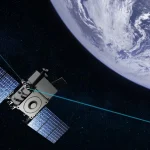
ViaSat-3 F2 operates from geostationary orbit approximately 35,786 kilometers above Earth, while Starlink satellites operate in low Earth orbit. Both architectures reuse Ka-band spectrum through narrow spot beams, but they manage interference in fundamentally different ways.
A GEO high-throughput satellite can concentrate capacity over persistent service areas. An NGSO constellation obtains global coverage by handing traffic among rapidly moving spacecraft. Although directional antennas and angular separation allow the two types of network to share spectrum, interference risk rises when a Starlink terminal, a Starlink satellite and ViaSat-3 F2 approach the same line of sight.
This geometry can temporarily reduce antenna discrimination—the ability of an antenna to separate a desired signal from an unwanted transmission arriving from another direction. The resulting increase in interference can lower the carrier-to-interference-plus-noise ratio, forcing a communications system to adopt more robust modulation and coding, reduce throughput or interrupt a link.
The effect on users would depend on where and how frequently such alignments occur, the power and bandwidth assigned to individual beams, and the ability of both networks to reroute traffic. These variables make coordination agreements important: operators can exchange technical data, identify exclusion geometries and establish procedures for modifying beams or power levels before commercial operations begin.
Because ViaSat-3 F2 is a single high-capacity spacecraft, restrictions on particular frequencies would not necessarily disable the satellite. They could, however, reduce its available spectrum, constrain capacity allocation or complicate Viasat’s ability to move bandwidth dynamically across the Americas.
ViaSat-3 F2 is central to Viasat’s capacity recovery
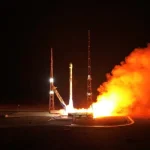
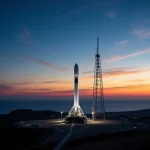
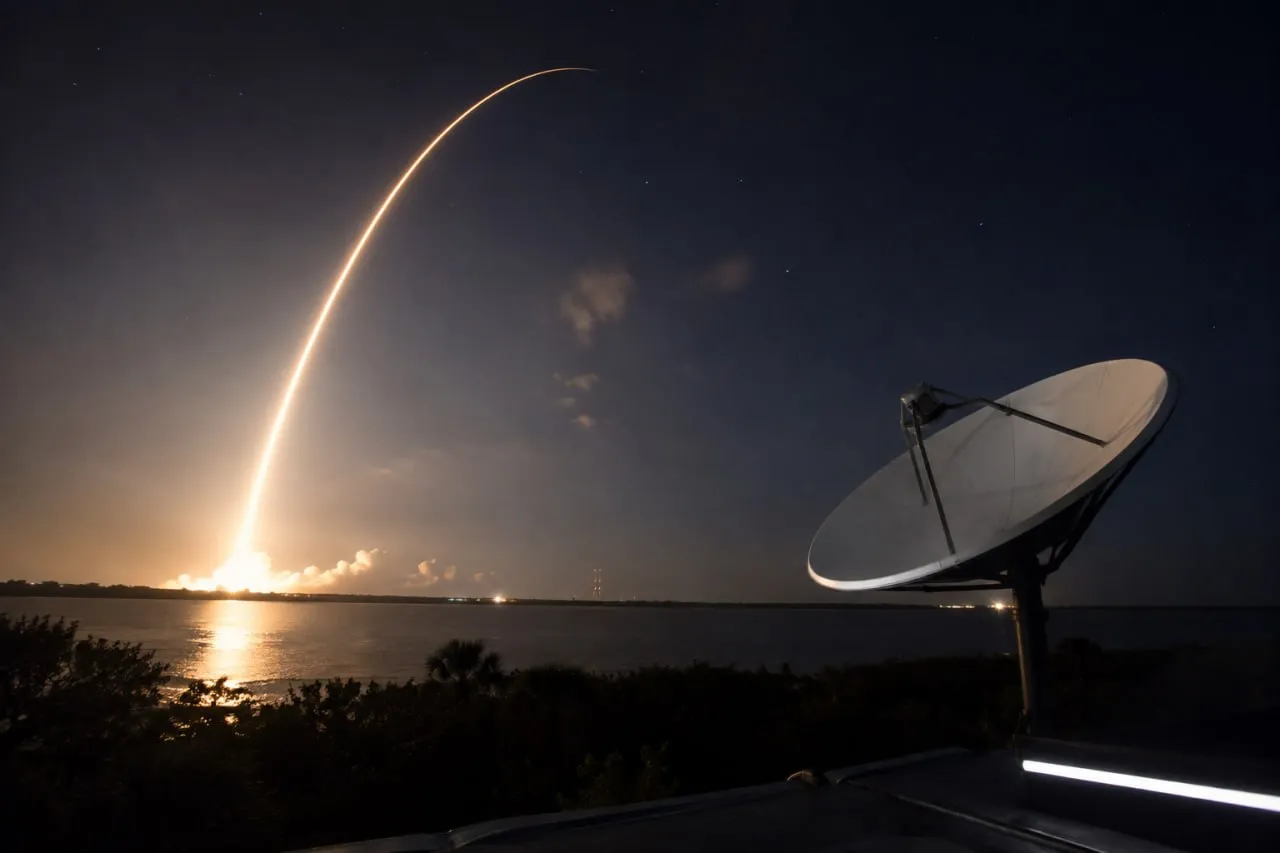
United Launch Alliance launched ViaSat-3 F2 aboard an Atlas V 551 from Cape Canaveral Space Force Station on November 13, 2025. The Boeing-built spacecraft subsequently raised its orbit, deployed its large reflector and began in-orbit testing at its geostationary operating position.
Viasat designed each ViaSat-3 satellite to provide more than 1 terabit per second of capacity, using a flexible Ka-band payload capable of directing bandwidth toward locations with changing demand. Target markets include commercial aviation, maritime connectivity, government users, enterprises and residential broadband.
F2 has assumed greater strategic importance following the antenna deployment anomaly on ViaSat-3 F1, launched in April 2023. That failure sharply reduced F1’s usable capacity and led Viasat to file a $421 million insurance claim. Viasat subsequently repositioned its deployment strategy, assigning F2 to the Americas rather than its originally planned Europe, Middle East and Africa coverage role.
The dispute therefore reaches beyond a routine spectrum proceeding. Any limitation that delays F2’s service entry or reduces its usable Ka-band capacity would affect Viasat’s effort to restore growth in the Americas and expand bandwidth for mobility customers.
A regulatory contest between competing satellite architectures
SpaceX and Viasat have repeatedly opposed each other’s FCC applications. Viasat has challenged Starlink constellation expansions, higher-power operations and direct-to-device plans, citing interference, orbital-safety and competitive concerns. SpaceX has accused Viasat of attempting to use regulatory proceedings to constrain an NGSO competitor while operating geostationary satellites in spectrum designated primarily for NGSO systems.
Amazon has also questioned ViaSat-3 F2’s proposed use of NGSO-primary Ka-band frequencies. The involvement of multiple constellation operators indicates that the outcome could establish a broader precedent for how strictly the FCC enforces coordination conditions when GEO and NGSO networks seek access to the same spectrum.
The FCC must balance two objectives: protecting earlier NGSO systems from harmful interference and avoiding unnecessary restrictions on a high-capacity GEO satellite that could introduce additional broadband competition. It could deny SpaceX’s petition, impose tighter operating conditions, require additional technical submissions or prevent Viasat from using the contested bands until coordination is completed.
The case also illustrates an emerging constraint on satellite broadband expansion. Orbital capacity is growing rapidly, but usable spectrum remains finite. Advanced phased arrays, digital payloads and dynamic beamforming improve frequency reuse; they do not eliminate the need for operators to coordinate overlapping networks. As GEO and LEO providers direct increasingly powerful and flexible beams toward the same markets, spectrum engineering and regulatory priority will become as consequential as launch capacity or satellite manufacturing.