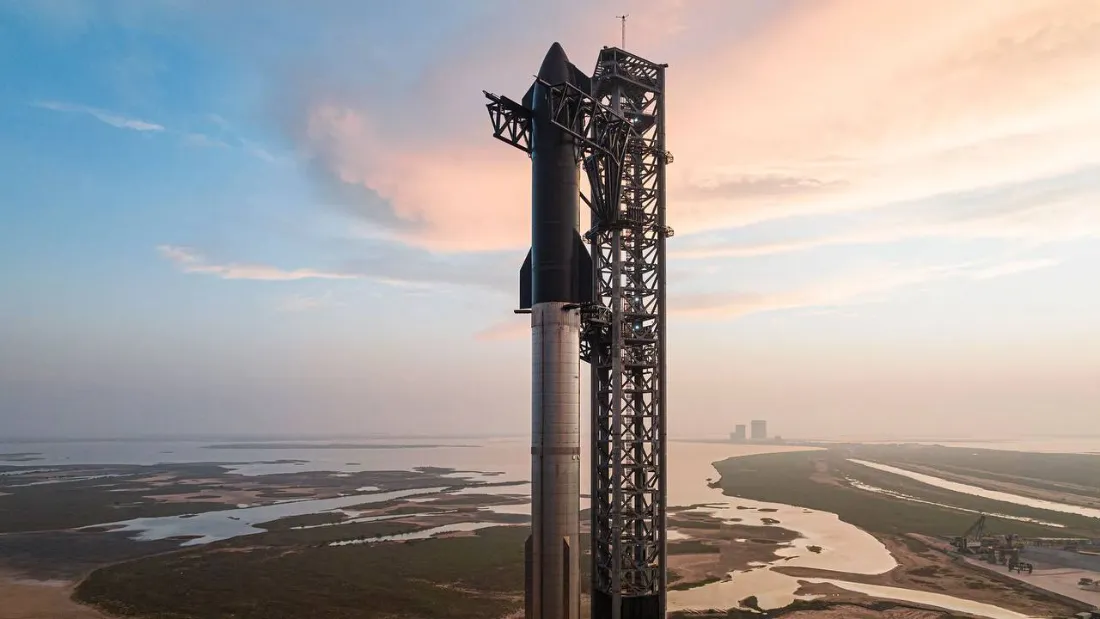
SpaceX is targeting Tuesday, September 22, 2026, for Starship’s 14th flight test from Starbase in South Texas. The mission would be Starship’s first attempt to enter Earth orbit and is planned to deploy 26 Starlink V3 satellites. A 75-minute launch window opens at 7:15 a.m. Central time, pending regulatory approval.
Previous Starship tests followed suborbital trajectories designed to keep the vehicle passively safe while SpaceX gathered flight data. Flight 14 would extend testing to orbital insertion, operations in space and a deliberate deorbit burn—steps needed to develop a fully and rapidly reusable vehicle.
SpaceX plans for the upper stage to fly at approximately 275 kilometers altitude, complete about six orbits over nearly 10 hours, then reenter and splash down in the Pacific Ocean west of Chile. The flight team will authorize the orbital insertion burn only after confirming sufficient redundancy in hardware needed for the later deorbit burn, which is planned to use a single Raptor engine.
The Super Heavy booster has a separate test profile: launch, ascent, stage separation, a boostback burn and a landing burn toward an offshore splashdown point in the Gulf of Mexico. SpaceX has made engine filtering and software changes following Flight 13. On that flight, the booster used all 33 engines for its boostback burn for the first time, but signs of ice clogging in its three center engines ended the maneuver early. Eight of the 13 engines planned for the subsequent landing burn reignited, and the booster made a hard splashdown.
The satellite deployment would also put Starship to work on SpaceX’s next phase of Starlink expansion. SpaceX says each V3 satellite adds 1 terabit per second of network capacity. On that basis, the 26 satellites would add a combined 26 Tbps—about 10 times the capacity the company attributes to a Falcon 9 launch of V2 Mini satellites.
After deployment, the satellites are expected to unfold their antennas, deploy their solar arrays, establish radio-frequency and laser communications, and raise their orbits using onboard thrusters. SpaceX expects them to begin serving customers a few weeks after launch, subject to successful on-orbit checkout.
Three of the satellites carry cameras intended to image Starship’s heat shield and relay the views to operators. The imagery will support SpaceX’s work on assessing heat-shield readiness for future missions that return the upper stage to its launch site.
The September 22 target remains subject to regulatory approval and the results of launch preparations. SpaceX plans to begin its webcast about 30 minutes before liftoff and continue coverage through the planned splashdown.