Over the past year, space computing has emerged as one of the hottest topics in the global commercial space industry.
From a wave of domestic companies announcing plans for computing satellites, computing constellations, and space-based computing platforms, to SpaceX’s continued discussions around orbital data centers and AI infrastructure, space computing has quickly become a new buzzword in the commercial space sector.
However, as discussions around the concept have expanded, different forms of “space computing” have increasingly been grouped together as if they were the same thing.
Some believe that what Chinese companies are developing is essentially the same as what Elon Musk is pursuing. Others argue that China has already entered the era of orbital data centers.
In reality, these are fundamentally different concepts.
Today’s industry discussions around space computing include at least three different models. They address different problems, serve different users, and follow different development paths.
Onboard Intelligence: Making Satellites Smarter
This is currently the most mature model and one that is expected to become widely adopted in the future.
Traditionally, satellites mainly performed one task: collecting data and transmitting it back to Earth for processing. But with the rapid development of artificial intelligence, more and more data-processing tasks are now being moved directly onto satellites, including remote sensing target recognition, object detection, data filtering, anomaly identification, and intelligent task scheduling.
In other words, satellites are no longer just responsible for observing — they are beginning to develop the ability to analyze and make decisions.
This model is essentially the integration of AI and satellites, often referred to as onboard intelligence or edge computing in space.
In the future, almost every satellite is expected to be equipped with stronger computing capabilities and intelligent algorithms, becoming a fundamental capability for the next stage of commercial space development.
Computing Constellations: Building Orbital Computing Networks
The second model is also the direction where many Chinese companies are currently focusing their efforts.
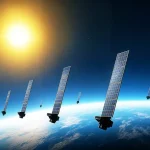
Unlike onboard intelligence, which improves the computing capability of individual satellites, this approach aims to deploy a network of computing satellites centered around processing power. These satellites are connected through inter-satellite communication links to form an orbital computing network, providing in-orbit computing services for other satellites.
Why is this necessary?
Because today, a large amount of data collected by remote sensing satellites cannot be fully transmitted back to Earth.
Limited by satellite-to-ground communication bandwidth, ground station resources, and operational costs, only a portion of collected data can be downloaded and processed in time. A significant amount of information remains underutilized.
If intelligent analysis can be completed directly in orbit, satellites can transmit only the most valuable information back to Earth. This would not only improve data utilization efficiency but also significantly enhance the operational efficiency of entire satellite constellations.
This is precisely the problem that many domestic projects focused on “computing constellations” and “space computing clouds” are attempting to solve.
Simply put, this approach enables satellites to process satellite-generated data in space — a concept often described within the industry as:
“computing in space for data from space.”
Orbital Data Centers: Extending AI Infrastructure into Space
The third model is currently receiving the greatest international attention: orbital data centers.
Unlike the previous two approaches, orbital data centers are not designed primarily to serve satellites. Instead, they target the rapidly growing global demand for artificial intelligence computing infrastructure.
As large AI models continue to expand, terrestrial data centers are facing increasing pressure. Electricity consumption is rising, land availability is becoming more limited, and cooling requirements and carbon emissions are creating additional challenges.
This has led to a new vision:
Can data centers be built directly in space?
The concept is to utilize the orbital environment to obtain continuous solar power, while using space-based communication networks to provide computing services for users on Earth.
In recent years, international companies have accelerated exploration in areas such as orbital data centers and space-based AI infrastructure.
This model is no longer focused on how satellite data is processed. Instead, it addresses a much larger question:
How will global AI computing infrastructure evolve in the future?
It represents another development path:
“computing on Earth using infrastructure in space.”
What Are the Key Differences?
Therefore, although all three concepts are referred to as “space computing,” the focus of domestic companies and international explorers is not exactly the same.
Chinese companies are currently concentrating more on making satellites smarter — enabling satellites to process data in orbit, improving data utilization efficiency and constellation performance.
Meanwhile, international exploration represented by orbital data centers focuses more on another question:
How can terrestrial computing infrastructure be extended into orbit to support the future growth of global AI demand?
One is primarily aimed at space applications.
The other is exploring the future of global computing infrastructure.
They are not competing alternatives, nor is one necessarily more advanced than the other.
Instead, they address different challenges and represent two important development paths that may coexist in the future of space computing.
Which Segments of Space Computing Deserve Attention?
At present, China’s space computing industry is still in its early stages.
The concept has taken shape, and numerous projects are emerging, but mature industrial ecosystems and sustainable commercial models are still under development.
For the industry, the more important questions today are:
- Which segments will achieve commercialization first?
- Which technologies will become the next major bottlenecks?
- Which companies have the ability to sustain long-term innovation?
- Which emerging sectors will become the core industries of the next decade?
The answers to these questions may determine the future competitive landscape of the global space computing industry.