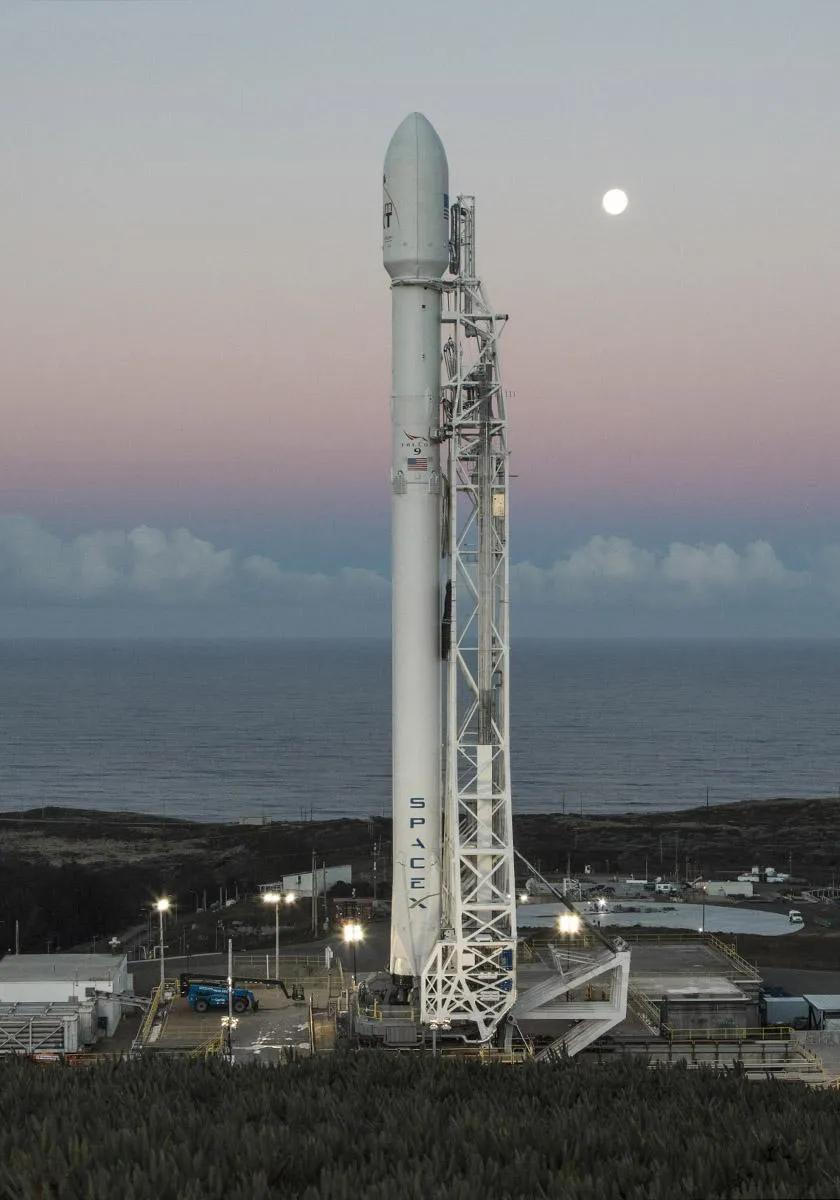
Portal Space Systems has secured an entire SpaceX Falcon 9 launch for its first Supernova spacecraft mission, a move that gives the Washington-based company direct control over launch timing while creating new rideshare opportunities for other satellite operators.
The company announced on Aug. 20 that Falcon 9 will launch its Motus Via Sol mission in 2028. The flight will carry the inaugural Supernova spacecraft and serve as the first in-space demonstration of Portal’s proprietary FLARE solar thermal propulsion system, a technology designed to enable rapid maneuvering across multiple orbital regimes.
Portal has partnered exclusively with California-based Maverick Space Systems to integrate payloads and market excess launch capacity. While Supernova will occupy a significant portion of the vehicle’s payload volume, the remaining capacity will be offered to commercial customers through rideshare arrangements.
A Rare Move for a Spacecraft Startup
Purchasing an entire Falcon 9 mission is unusual for an emerging spacecraft developer. Most startups rely on scheduled rideshare programs or piggyback opportunities because dedicated launches involve substantial financial commitments and require long-term mission planning.
Portal’s leadership argues that securing a launch years in advance provides greater certainty in an increasingly constrained launch market. By controlling the primary payload position and overall mission architecture, the company can align launch schedules with customer requirements rather than adapting spacecraft plans to available rideshare opportunities.
The strategy reflects broader changes in the commercial launch sector. Demand for orbital access has surged as satellite constellations, defense missions, Earth-observation fleets, and in-space logistics providers compete for launch slots. Although SpaceX has dramatically increased launch cadence with Falcon 9, access to specific orbits and schedules can still be constrained for spacecraft operators seeking tailored mission profiles.
Motus Via Sol and the FLARE Propulsion Demonstration
The 2028 mission’s name, Motus Via Sol—Latin for “movement with the sun”—references Portal’s FLARE propulsion technology. Unlike conventional chemical propulsion systems that carry both fuel and oxidizer, solar thermal propulsion uses solar energy to heat propellant and generate thrust.
Portal believes the approach can offer a combination of efficiency and responsiveness that bridges the gap between traditional chemical propulsion and electric propulsion systems. Electric propulsion generally provides excellent fuel economy but low thrust, often requiring months to reach operational orbits. Solar thermal systems seek to deliver significantly faster orbital transfers while maintaining improved efficiency relative to conventional chemical engines.
The Supernova spacecraft is being designed around this concept. The vehicle is intended to move rapidly between orbital regimes, enabling missions that require responsive maneuvering, orbital repositioning, or access to multiple destinations during a single operational lifetime.
If successful, the demonstration could validate a propulsion architecture with applications ranging from national security missions to commercial satellite servicing and space logistics.
Building on Earlier Demonstration Missions
The Supernova flight is not Portal’s first attempt to validate its technologies.
The company has been developing a progression of increasingly capable spacecraft. Earlier demonstrations are intended to prove key subsystems, orbital maneuvering capabilities, and rendezvous operations before Supernova enters service.
Portal’s Starburst spacecraft program is designed to demonstrate rapid orbital changes and maneuverability while sharing key technologies with the larger Supernova platform. The company has also planned smaller technology demonstrations focused on validating its solar thermal propulsion approach in space before the full-scale Supernova mission.
This incremental development strategy mirrors approaches used by several successful commercial space companies, which often fly progressively more capable spacecraft before deploying operational systems.
How the Rideshare Opportunity Differs from Traditional Falcon Missions
One of the more notable aspects of the announcement is the way Portal intends to use excess launch capacity.
SpaceX already operates highly successful rideshare programs through its Transporter and Bandwagon missions, providing relatively low-cost access to orbit for small satellites. However, those missions typically deploy large numbers of spacecraft into predetermined orbits, leaving customers responsible for “last-mile” transportation to their final destinations.
Portal argues that its highly maneuverable spacecraft architecture creates additional flexibility. Because Supernova and related vehicles can rapidly transfer between orbital destinations after deployment, the mission is less dependent on a specific insertion orbit. That flexibility may allow the launch to accommodate customers with different orbital requirements while still meeting Portal’s own mission objectives.
Maverick Space Systems will manage payload accommodation and integration across the mission, including ESPA-class payloads and smaller “cake-topper” spacecraft positioned near the top of the launch stack. The company’s leadership has extensive experience in small-satellite deployment and launch integration, having participated in hundreds of satellite launches over the past two decades.
The Growing Market for Highly Maneuverable Spacecraft
Portal is entering a rapidly expanding segment of the space industry focused on mobility and orbital agility.
For decades, most satellites were designed to remain in relatively fixed orbital positions after deployment. Increasingly, however, commercial operators and government agencies are seeking spacecraft capable of relocating, inspecting other satellites, avoiding threats, servicing assets, or delivering payloads across multiple orbital destinations.
The U.S. Space Force and intelligence community have shown particular interest in maneuverable spacecraft as concerns grow over orbital congestion, space sustainability, and the need for resilient space architectures. Commercial operators are also exploring orbital transfer vehicles, in-space transportation services, and responsive logistics networks.
Companies such as Impulse Space, Momentus, and several emerging orbital transfer vehicle providers are pursuing related markets, although Portal’s focus on solar thermal propulsion represents a different technical path than many competitors.
Why Falcon 9 Remains the Preferred Launch Vehicle
The selection of Falcon 9 underscores the rocket’s continued dominance in the commercial launch sector.
Since its introduction, Falcon 9 has become the industry’s most frequently flown orbital launch vehicle, benefiting from reusability, a high launch cadence, and an extensive operational record. The rocket’s combination of reliability and availability has made it the preferred choice for a broad range of government and commercial missions.
For spacecraft developers planning first-of-kind missions, Falcon 9 offers an established launch environment that reduces risk compared with newer launch systems still building flight heritage.
That reliability is particularly important for Portal’s Supernova debut because the mission will simultaneously validate a new spacecraft platform and a new propulsion technology. Minimizing launch-related uncertainty allows engineers to focus on evaluating the spacecraft and propulsion system itself.
Preparing for a 2028 Milestone
The Motus Via Sol mission represents a major milestone for Portal Space Systems as it seeks to transition from development and demonstration activities into operational spacecraft deployment.
Beyond launching the first Supernova vehicle, the mission will test whether FLARE solar thermal propulsion can deliver the rapid orbital mobility that the company has promised. Success would strengthen Portal’s position in emerging markets that require highly maneuverable spacecraft capable of operating across multiple orbital environments.
The dedicated Falcon 9 contract also highlights a broader shift in the commercial space industry. As access to orbit becomes increasingly strategic, some spacecraft operators are choosing to secure launch capacity years in advance rather than relying solely on shared rideshare opportunities. For Portal, that decision provides control over a critical mission while creating additional launch opportunities for other satellite operators seeking access to space in 2028.