Starcloud has raised a $250 million extension to its Series A financing round, giving the orbital computing startup fresh capital as it races to deploy space-based AI infrastructure in an increasingly competitive launch market. The new funding values the company at approximately $2.3 billion and comes just months after Starcloud achieved unicorn status with a $170 million Series A announced in March.
The latest round was led by Manhattan West and included participation from both existing investors and strategic technology backers, including NVIDIA and Cisco Investments. The funding arrives at a pivotal moment for the emerging orbital data center sector, where companies are competing not only for customers and computing hardware but also for increasingly scarce launch opportunities needed to deploy large satellite networks. Starcloud’s announcement highlights how access to launch capacity is becoming a strategic bottleneck for a new generation of space infrastructure ventures.
From Orbital Computing Demonstrations to Industrial-Scale Expansion
Founded in 2024, Starcloud has rapidly emerged as one of the most closely watched companies in the growing market for space-based computing. The company aims to move portions of AI processing and cloud computing infrastructure into orbit, where spacecraft can theoretically take advantage of nearly continuous solar power while avoiding some of the energy and cooling constraints facing terrestrial data centers.
The company gained attention in late 2025 when it launched Starcloud-1, a demonstration satellite carrying an NVIDIA H100 GPU. According to the company, the mission successfully demonstrated high-performance AI computing in orbit, including large language model operations and machine-learning workloads. Those demonstrations were intended to validate the concept that sophisticated AI processing can be performed directly in space rather than relying exclusively on Earth-based facilities.
The newly announced funding will support Starcloud’s next generation of orbital computing satellites and broader infrastructure deployment plans. The company has also been collaborating with NVIDIA on what it calls the NVIDIA Space-1 Vera Rubin Module, signaling increasingly close ties between the space and artificial intelligence sectors.
Why Companies Want Data Centers in Space
The concept of orbital data centers has moved from science fiction to serious commercial discussion largely because of the explosive growth in artificial intelligence workloads.
Modern AI systems require enormous amounts of electrical power, cooling capacity, and physical infrastructure. Major technology companies are investing hundreds of billions of dollars in terrestrial data centers, creating concerns about electricity demand, water consumption, land use, and grid capacity.
Advocates of space-based computing argue that orbital platforms offer several potential advantages:
* Continuous access to solar energy in specialized orbits.
* Elimination of many terrestrial cooling requirements.
* Reduced dependence on regional power grids.
* On-orbit processing of satellite imagery and sensor data.
* Potential long-term scalability beyond Earth’s infrastructure constraints.
For Earth-observation satellites, processing data directly in orbit could also reduce the need to transmit massive volumes of raw information back to Earth. Instead, spacecraft could analyze imagery, identify relevant events, and transmit only actionable results.
This edge-computing model is often viewed as one of the earliest commercially viable applications for orbital computing infrastructure.
Launch Capacity Becomes a Strategic Resource
One of the most significant themes emerging from Starcloud’s fundraising announcement is the growing importance of launch access.
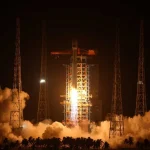
The company and its competitors ultimately depend on frequent, affordable launches to deploy thousands—or potentially tens of thousands—of spacecraft. While reusable rockets have dramatically lowered launch costs over the past decade, demand for launch services is expanding even faster.
Satellite broadband constellations, Earth-observation fleets, national security spacecraft, lunar missions, and emerging orbital infrastructure projects are all competing for launch opportunities. As more companies seek to deploy large constellations, launch manifests are becoming increasingly crowded.
For a company pursuing orbital data centers, deployment schedules are especially important because computing capacity scales directly with the number of satellites in orbit. Delays in launch availability can therefore slow revenue generation, technology validation, and customer acquisition.
The issue is likely to become even more significant later in the decade as multiple companies attempt to deploy next-generation space infrastructure networks simultaneously.
A Crowded Race for Space-Based AI Infrastructure
Starcloud is not alone in pursuing orbital computing.
Several major players have expressed interest in moving portions of AI infrastructure beyond Earth. SpaceX has discussed large-scale orbital computing concepts tied to its Starlink and Starship ecosystems. Blue Origin has also explored future space infrastructure architectures that could support large computing platforms in orbit.
At the same time, startups such as Aetherflux are attracting investor interest by pursuing complementary space-based energy and computing concepts.
The involvement of NVIDIA is particularly noteworthy because advanced AI hardware remains one of the most critical components of the industry. Access to state-of-the-art processors may prove just as important as access to rockets in determining which companies emerge as leaders in orbital computing.
Investor enthusiasm reflects broader confidence that demand for AI processing will continue growing for years. Venture capital firms increasingly view space infrastructure as a potential solution to the power and scaling challenges confronting terrestrial AI expansion.
Technical Challenges Remain Significant
Despite growing excitement, orbital data centers still face substantial engineering and economic hurdles.
Spacecraft carrying powerful processors must dissipate large amounts of heat in an environment where convection cooling is impossible. Instead, thermal energy must be radiated away through specialized cooling systems and radiators.
Communications also present a challenge. Data must be transmitted efficiently between orbiting processors and users on Earth, requiring high-capacity links and sophisticated networking architectures.
Reliability is another concern. Unlike terrestrial servers, orbital computing systems cannot be easily repaired or upgraded. Hardware failures may require replacement satellites, increasing operational costs.
Economics remain equally important. Although launch costs have fallen dramatically, deploying large-scale computing infrastructure in orbit is still expensive. Industry analysts generally believe that continued reductions in launch prices—potentially enabled by fully reusable heavy-lift systems—will be necessary before orbital data centers can compete broadly with conventional facilities for general-purpose computing workloads.
As a result, many observers expect early commercial applications to focus on specialized missions such as satellite data processing, defense intelligence, secure communications, and remote sensing analytics before expanding into broader AI cloud services.
Regulatory and Constellation Ambitions
Starcloud’s long-term plans are exceptionally ambitious. Earlier this year the company pursued regulatory approval for a constellation that could eventually include tens of thousands of satellites dedicated to orbital computing operations.
Such proposals illustrate how rapidly the scale of space infrastructure ambitions has expanded. Just a few years ago, mega-constellations were primarily associated with broadband connectivity. Today, companies are discussing orbital power generation, space manufacturing, and distributed AI computing networks on a comparable scale.
These plans will inevitably draw attention from regulators, astronomers, and space sustainability experts concerned about orbital congestion and debris mitigation. Any future deployment at the scale envisioned by Starcloud would require extensive coordination with regulators and international space traffic management efforts.
Investment Signals Confidence in a New Space Infrastructure Category
The latest $250 million funding extension underscores growing investor confidence that orbital computing could evolve into a major category within the space economy.
The participation of established technology companies alongside venture investors suggests that space-based computing is increasingly being viewed not merely as a speculative concept but as a potential extension of future cloud and AI infrastructure.
Whether orbital data centers ultimately become a mainstream computing platform remains uncertain. However, Starcloud’s rapid rise—from startup formation in 2024 to a multi-billion-dollar valuation in 2026—demonstrates how quickly investor interest has shifted toward technologies that promise to address the escalating resource demands of artificial intelligence.
For now, the company’s immediate challenge is clear: transform promising demonstrations into scalable operational systems while securing the launch capacity necessary to place those systems in orbit. Success or failure may help determine whether the next generation of AI infrastructure remains on Earth—or increasingly migrates beyond it.
Conclusion
Starcloud’s $250 million funding extension represents more than another large venture capital round. It highlights the convergence of two powerful trends: the explosive growth of AI computing demand and the maturation of commercial space infrastructure. As launch availability tightens and competition intensifies, the company is positioning itself to become a leading player in a market that could redefine how computing resources are deployed and powered in the decades ahead.