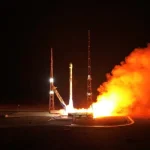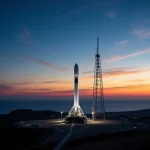
A SpaceX Falcon 9 carrying a new batch of Starlink satellites marked the end of an era on Aug. 25, completing what the company says will be its final dedicated Starlink launch from Florida. The early-morning mission also produced a striking “space jellyfish” effect that was visible hundreds of miles from the launch site, including over the New York City metropolitan area.
The rocket lifted off from Cape Canaveral Space Force Station before dawn, sending Starlink satellites into low Earth orbit while creating a glowing plume that appeared above the northeastern United States shortly before sunrise. Images and videos captured from New Jersey, New York, Washington, D.C., and other East Coast locations showed the Falcon 9 silhouetted against the twilight sky as its exhaust expanded into a luminous, jellyfish-shaped cloud.
The mission was notable not only for the visual spectacle but also for its strategic significance. SpaceX has indicated that future Starlink deployments from Florida will transition to Starship, the company’s next-generation fully reusable launch system, as it moves toward phasing out Falcon 9 operations for most Starlink missions.
Why Rocket Launches Create “Space Jellyfish” Phenomena
The “space jellyfish” effect occurs when a rocket launches during twilight conditions, either shortly before sunrise or after sunset. At high altitude, rocket exhaust containing water vapor and other combustion products expands rapidly into the near-vacuum environment. Although observers on the ground may still be in darkness, the exhaust plume is illuminated by sunlight above the horizon, causing it to glow dramatically against the darker sky.
The phenomenon has become increasingly familiar to residents near major launch corridors as launch cadence has accelerated. Falcon 9 missions from both Florida and California have generated similar displays in recent years, often attracting widespread attention on social media and among amateur astronomers.
From an engineering perspective, the effect is enhanced by the high-altitude expansion of the upper-stage exhaust plume, which can spread across hundreds of kilometers. Atmospheric conditions, launch azimuth, vehicle altitude, and solar geometry all influence the final appearance.
Final Florida Starlink Mission Reflects Broader Fleet Transition
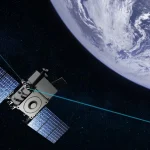
The launch underscores a major shift in SpaceX’s launch architecture. Falcon 9 has been the workhorse behind the deployment of the Starlink constellation, which has grown into the largest satellite network ever assembled, with more than 11,000 satellites in orbit.
Throughout 2026, Starlink missions have accounted for the majority of SpaceX launches, helping the company surpass 100 Falcon-family missions for the year. The high flight rate has been enabled by increasingly mature booster reuse practices, including multiple first stages that have flown more than 30 times.
However, Starship is expected to eventually assume the bulk of Starlink deployment responsibilities. The vehicle’s significantly larger payload capacity could allow SpaceX to launch larger numbers of satellites per mission, including future Starlink V3 spacecraft that are designed around Starship’s volume and mass capabilities.
The transition is strategically important because constellation economics increasingly favor larger launch vehicles. Deploying more satellites per flight reduces launch costs on a per-satellite basis and supports faster replenishment and expansion of broadband networks.
Falcon 9’s Legacy in Commercial Spaceflight
Since entering service in 2010, Falcon 9 has transformed the commercial launch market through routine first-stage recovery and reuse. The vehicle has completed nearly 700 missions and established operational benchmarks that competitors worldwide continue to pursue.
Recent missions have demonstrated the maturity of the system. On Aug. 25, SpaceX flew its 100th Falcon mission of 2026 while setting a new company record with a booster completing its 37th flight. The company has also demonstrated unprecedented launch cadence, including two orbital missions separated by only 38 minutes earlier this month.
Although Falcon 9 launches from California will continue for now, SpaceX leadership has stated that Falcon 9 and Falcon Heavy are expected to be retired once Starship achieves reliable, high-frequency operational service. Current planning points toward a gradual phaseout later this decade, though some government and NASA missions may continue using Falcon vehicles until Starship receives full certification for those roles.
Implications for the Starlink Program
For Starlink, the final Florida Falcon 9 mission represents more than a launch-site milestone. It highlights the growing integration between SpaceX’s satellite and launch businesses.
Starlink has become the primary demand driver for Falcon 9 flights, while Starship is being developed partly to support the next phase of constellation growth. Future Starlink satellites are expected to be larger, more capable, and increasingly optimized for direct-to-device connectivity and higher network throughput. Those capabilities depend on launch systems that can deliver substantially greater mass to orbit than Falcon 9.
As a result, the Aug. 25 mission may be remembered not only for the spectacular dawn display seen across the East Coast, but also as one of the final milestones in the Falcon 9-led deployment phase of the Starlink constellation.