China has reported a major copper-gold exploration breakthrough in Anhui province, identifying what researchers describe as the largest porphyry copper-gold deposit yet found in the Middle-Lower Yangtze region and challenging conventional assumptions about where large porphyry systems can form.
China’s Ministry of Natural Resources announced the latest exploration results on Sept. 1. The breakthrough centers on the Chating porphyry copper polymetallic deposit in Xuanzhou District of Xuancheng, where exploration has clarified the scale of the Shangchangcun copper-gold orebody while revealing further resource potential at depth, along its margins and in surrounding areas.

Azurite. Photo by Wang Zehua.
Preliminary estimates indicate that the mining area contains potential copper resources exceeding the scale of several large copper deposits, with 500,000 metric tons used as the threshold for a large copper deposit. Potential gold resources exceed the equivalent of more than 10 large gold deposits, for which the corresponding threshold is 20 metric tons.

Native gold. Photo by Wang Zehua.
The deposit could eventually support a very large copper-gold production base in eastern China. But Chating’s significance goes beyond its resource potential: the discovery provides new evidence for large-scale copper-gold mineralization in volcanic basins previously considered less favorable for giant porphyry systems, potentially expanding the exploration search space across eastern China.
Largest Porphyry Copper-Gold Deposit Yet Identified in the Region
Chating is a gold-rich porphyry copper-gold deposit within the Nanling-Xuancheng copper-gold district of the Middle-Lower Yangtze metallogenic belt.
Lin Bin, deputy director of the Deep Earth Prediction and Potential Evaluation Research Office at the Chinese Academy of Geological Sciences and the on-site technical lead, described Chating as the largest porphyry copper-gold deposit discovered to date in China’s Middle-Lower Yangtze region.
That is particularly notable because many of China’s very large porphyry copper deposits discovered in recent years are concentrated in western plateau regions. Deposits of Chating’s apparent scale are comparatively rare in the Middle-Lower Yangtze.
The research team formally entered the Chating exploration project at the beginning of 2026, building on earlier work by the Anhui geological authorities and an enterprise-funded exploration program.
Researchers systematically reviewed previous exploration and geological data before carrying out regional metallogenic and deposit studies, geological and topographic surveys, hydrogeological and environmental investigations, high-power three-dimensional induced-polarization surveys, ore-processing performance evaluations and resource estimation.
In just four months, more than 70 boreholes were completed.

Drill core from the Chating copper-gold deposit exploration program. Photo courtesy of China’s Ministry of Natural Resources.
The main orebody delineated so far is approximately 1.2 kilometers long and 1.1 kilometers wide. The maximum mineralized thickness encountered in a single borehole exceeds 1,370 meters.
Across the broader campaign, more than 100,000 meters of drilling was completed.
The combination of a relatively compact surface footprint and substantial mineralization led the exploration team to characterize the result as a “small area, large resource” discovery.
A 2,000-Meter Borehole Still Has Not Reached the Bottom
One of the most important indications that Chating remains an evolving discovery is what the deepest drilling has not yet found: the bottom of the mineralized system.
The deepest exploration borehole completed so far extends beyond 2,000 meters, but it has not penetrated the lower boundary of the orebody.
Researchers are therefore planning a 3,000-meter scientific borehole.
The next drilling phase is intended not only to test additional deep resource potential, but also to investigate the architecture of the porphyry copper mineralization system beneath a continental volcanic basin. The results could help establish an exploration model applicable to similar concealed deposits elsewhere in eastern China.
The current resource figures should therefore be understood as estimates of potential rather than final mineable reserves.
Before a discovery of this scale becomes a producing mine, additional work is normally required to improve resource confidence and determine grade continuity, mineralogy, metallurgical recovery, hydrogeological and geotechnical conditions and the economics of extraction.
The Chating campaign has already included ore-processing performance studies and resource estimation. The immediate objective identified by the exploration team is to accelerate further resource delineation and ultimately support increased production.
The fact that the deepest borehole has yet to define the bottom of the mineralized body also means the deposit’s ultimate vertical extent remains unresolved.
Chating Could Become a Major Copper-Gold Supply Base in Eastern China
Geography gives the discovery strategic significance beyond its geological size.
Chating lies in the Yangtze River Delta hinterland, one of China’s most concentrated regions for copper smelting, wire and cable manufacturing, renewable energy and advanced manufacturing. Eastern China, however, has relatively limited indigenous primary copper and gold resources.

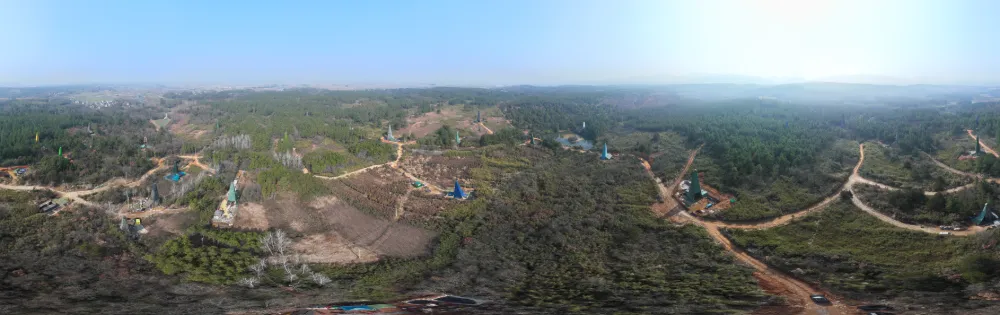
Chating Copper-Gold Deposit in Anhui Province
Much of the copper concentrate required by downstream industries must consequently be transported from western China or sourced from international markets, increasing transport requirements and exposing regional supply chains to external disruptions.
A major producing copper-gold asset in Anhui could provide raw materials closer to those downstream industries.
Copper is particularly important to photovoltaic systems, wind power, energy storage, electric vehicles and power-grid construction, while gold has applications spanning high-end electronics and advanced materials as well as investment and reserve assets.
The exploration team said its objective is to help accelerate resource expansion and production, strengthen copper and gold self-sufficiency and resource continuity in the Middle-Lower Yangtze and eastern economic belt, and improve the security of strategic mineral supplies.
If successfully developed, Chating could become a very large copper-gold production base serving eastern China, reducing some long-distance transport requirements and dependence on imported feedstock.
The deposit also contains associated silver and sulfur resources. If subsequent metallurgical and economic work supports their recovery, these minerals could be produced alongside the principal copper and gold resources, improving overall resource utilization.
A single mine would not remove China’s broader dependence on international copper supply chains, but Chating could diversify domestic supply while placing a potentially large primary resource close to one of the country’s most important metals-processing and manufacturing regions.
The Geological Breakthrough May Be as Important as the Deposit
The most consequential aspect of Chating could ultimately be the exploration model it creates.
Classic porphyry copper models are strongly associated with convergent tectonic environments, including island arcs and continental-margin arcs. Major porphyry provinces in Chile and Peru, as well as deposits in Indonesia and the Philippines, are examples cited by the Chating research team.
Extensional volcanic basins, by contrast, have traditionally been considered less favorable environments for the formation of large porphyry copper-gold deposits.
Chating challenges that assumption.
Researchers said the results provide evidence for extensive Yanshanian-age copper-gold mineralization across the Middle-Lower Yangtze and demonstrate that volcanic basins covered by thick volcanic sequences in eastern China can contain large concealed porphyry systems.
That distinction is critical for exploration.
A large discovery creates one new resource. A successful geological model can change where companies and government geological programs search for the next group of resources.
Researchers have specifically identified volcanic basins around Xuancheng and Nanling in Anhui province and Lishui and Liyang in Jiangsu province as having potential for similar deposits.
China plans to expand geological exploration across volcanic basins in the Middle-Lower Yangtze metallogenic belt during the 15th Five-Year Plan period, with researchers arguing that the region should become a priority area for copper-gold exploration in eastern China.
If subsequent exploration validates similar systems elsewhere, Chating could become a reference model for finding deeply concealed porphyry copper deposits beneath volcanic cover rather than an isolated large discovery.
Integrated Exploration Becomes Critical as Targets Move Deeper
Chating also demonstrates the technical challenge facing modern mineral exploration: increasingly important targets may be concealed beneath thick cover and extend to considerable depths.
The exploration team used an integrated system combining three-dimensional induced polarization, hyperspectral techniques, geochemistry and remote sensing.
These datasets are complementary rather than interchangeable. Geophysical techniques can provide information about subsurface physical properties, geochemical surveys can identify anomalous elemental patterns, and hyperspectral and remote-sensing observations can contribute information on geology, alteration and structures where those signatures can be detected.
The purpose of integrating multiple datasets is to progressively reduce uncertainty before committing to increasingly expensive drilling.
That becomes particularly important when exploration moves from near-surface targets to boreholes extending 2,000 meters or more.
Chating therefore represents both a geological and an exploration-methodology breakthrough. Its “small area, large resource” characteristics were delineated through a combination of earlier geological work, integrated sensing and geophysical methods, and an intensive drilling campaign exceeding 100,000 meters.
The institutional structure was also important. The project was placed on a national priority exploration list; provincial, municipal and district natural-resource authorities supported implementation and local coordination; enterprises provided investment; and a Chinese Academy of Geological Sciences team led by Academician Tang Juxing worked on technical challenges in the field.
From Chating to the Search for the Next Concealed Deposit
The planned 3,000-meter scientific borehole will now test two questions simultaneously: how much farther the Chating mineralized system extends at depth, and whether researchers can refine a geological model that can be transferred to other volcanic basins in eastern China.
That gives the Sept. 1 announcement significance on three levels.
Chating is the largest porphyry copper-gold deposit yet identified in the Middle-Lower Yangtze region and still has unresolved deep and peripheral resource potential. Its location creates the possibility of a major primary copper-gold supply base close to the Yangtze River Delta’s industrial clusters. And the geological interpretation could expand the range of environments considered prospective for large porphyry systems across eastern China.
The discovery also underscores the role of remote sensing within a broader mineral-exploration workflow. Satellite Earth observation cannot replace geophysics, geochemistry or drilling, particularly for deeply buried ore bodies, but it can support regional reconnaissance, geological and structural interpretation, alteration mapping and target screening before more expensive field programs are deployed.
For exploration teams, that makes data selection as important as simply acquiring the highest-resolution imagery available. Different stages of mineral exploration can require different combinations of spatial, spectral and temporal resolution. STARPATH GLOBAL helps mining and exploration companies select satellite imagery according to specific project requirements, allowing customers to balance usable resolution, coverage and cost rather than paying for detail that may not materially improve a particular exploration task. China’s growing Earth observation capacity is also bringing a wider range of competitively priced satellite data to international users.
For organizations interested in applying Earth observation to mineral exploration but without an established remote-sensing capability, STARPATH GLOBAL’s FDE Pioneer Program provides a pathway to evaluate where satellite data can add value and determine an appropriate technical starting point before scaling into a larger imagery program.