If rocket engines could only be used once, the space economy would remain an expensive one-way journey. But as Falcon 9 first stages repeatedly return to their landing sites and Raptor engines fire again and again aboard Starship, that logic has been fundamentally rewritten: engine reusability is becoming a decisive factor in launch costs, flight frequency and the competitive landscape of the commercial space industry.
Over the past several years, competition in reusable rocket engines has spread from the United States to China. The field now includes SpaceX’s Merlin and Raptor, Blue Origin’s BE-4, China’s YF-100N/P and LandSpace’s TQ-12A, among a growing number of models. The global market is shifting from one dominant player surrounded by several challengers toward a multipolar race. So who is defining the next-generation heart of spaceflight?
When classified by propellant, reusable engines primarily follow two technological paths: liquid oxygen–methane and liquid oxygen–kerosene.
Liquid oxygen–kerosene technology is relatively mature in engineering applications. Kerosene can be stored at ambient temperature, is comparatively safe and is easier for launch sites to handle. Relevant engine cycles include gas-generator and oxygen-rich staged-combustion designs.
Liquid oxygen–methane requires cryogenic insulated storage, but its cleaner combustion simplifies post-flight servicing and makes it well suited to reuse. Available cycles include gas-generator, oxygen-rich staged combustion and full-flow staged combustion. Methane is also comparatively well suited to full-flow staged-combustion designs, which can deliver higher performance, although managing methane venting presents additional challenges.
When classified by engine cycle, reusable engines broadly follow two routes: open-cycle and closed-cycle designs.
Open-cycle engines feature mature technology that can be commercialized relatively quickly, along with simpler structures and lower costs. Most Chinese commercial launch companies currently use open-cycle engines because they are less complex and comparatively inexpensive to manufacture.
Closed-cycle engines offer higher combustion efficiency and chamber pressure, but generally come with higher manufacturing costs.
The following overview examines representative engines worldwide along the liquid oxygen–kerosene and liquid oxygen–methane technology paths, offering a clearer picture of the real competitive landscape.
Liquid Oxygen–Kerosene
1. Merlin 1D: Developed by SpaceX, this 80-metric-ton-thrust-class gas-generator-cycle engine has a throttle range of 40%–100%. It powers Falcon 9 and Falcon Heavy and made its first flight aboard Falcon 9 in 2013. Falcon 9 Block 5 first stages have now been recovered more than 600 times in total, with a single booster flying as many as 37 missions.
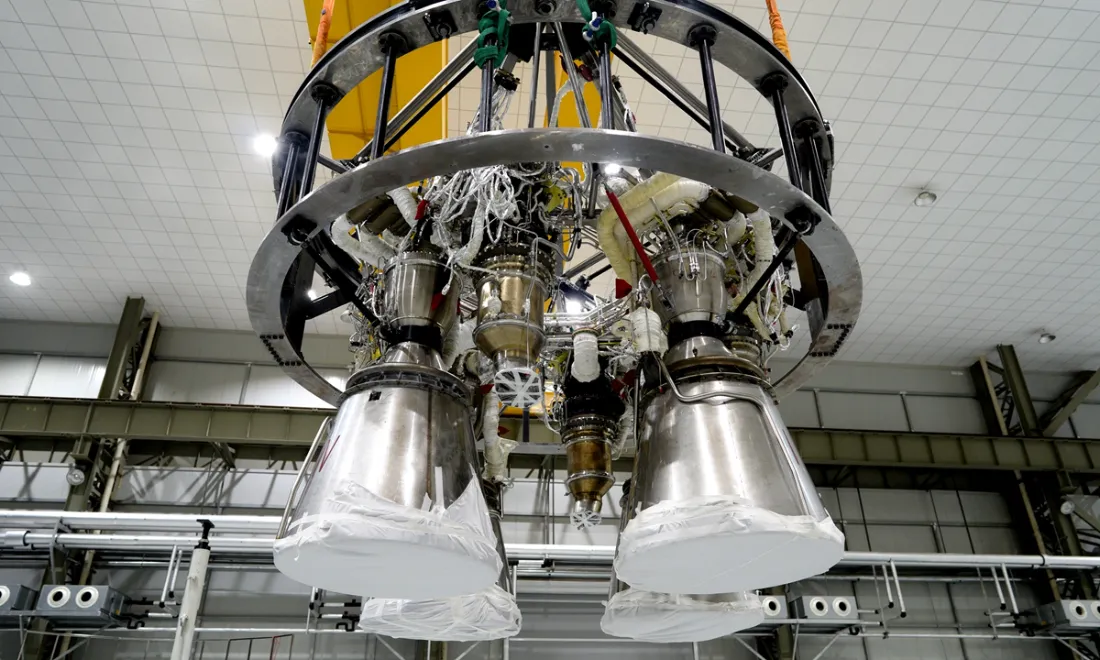
2. YF-102R: Developed by the Academy of Aerospace Propulsion Technology, this 80-metric-ton-thrust-class gas-generator-cycle engine has a throttle range of 50%–100%. It powers the Long March 12B. The rocket’s core first stage carries nine YF-102R engines, each capable of ±8 degrees of post-pump dual-axis gimbaling for thrust-vector control, while the core second stage uses one vacuum-optimized YF-102R. On June 1, 2026, the maiden Long March 12B lifted off from the China Commercial Space Launch test pad in the Dongfeng Commercial Space Innovation Pilot Zone and successfully placed the tenth batch of Qianfan constellation satellites into their designated orbits. No recovery test was attempted during the maiden flight.
3. YF-100N/P: Developed by the Academy of Aerospace Propulsion Technology, this 130-metric-ton-thrust-class engine uses a high-pressure oxygen-rich staged-combustion cycle and has a throttle range of 65%–105%. The version capable of ±8 degrees of post-pump dual-axis gimbaling is designated YF-100N, while the fixed version is known as YF-100P.
The engines are used on the Long March 10A, which carries five YF-100N engines and two YF-100P engines, and the Long March 10B. In its maiden-flight configuration, the Long March 10B used one central YF-100N surrounded by six engines arranged symmetrically in three pairs: YF-100N, YF-100P and YF-100L.
On July 10, 2026, the Long March 10B completed its maiden flight and achieved the world’s first net-based recovery of a first-stage rocket body. The YF-100N/P thus became China’s first liquid rocket engine to be successfully recovered after flight and the world’s first successfully recovered oxygen-rich staged-combustion liquid oxygen–kerosene engine.
4. YF-215: Developed by the Academy of Aerospace Propulsion Technology, this 200-metric-ton-thrust-class full-flow staged-combustion engine is intended to power the Long March 9.
5. TH-12: Developed by Space Pioneer, this 110-metric-ton-thrust-class gas-generator-cycle engine has a throttle range of 50%–110%. It powers the Tianlong-3, whose first stage carries nine TH-12 engines and whose second stage uses one TH-12V. On April 3, 2026, Tianlong-3 made its maiden flight from the Jiuquan Satellite Launch Center. The rocket experienced an anomaly after liftoff, and the flight test was unsuccessful.
6. Liqing-2: Developed by CAS Space, this 110-metric-ton-thrust-class gas-generator-cycle engine has a throttle range of 50%–100%. It is designed for the company’s reusable Kinetica launch vehicles.
7. Force-110: Developed by Orienspace, this 110-metric-ton-thrust-class gas-generator-cycle engine has a throttle range of 40%–110%. It is designed to power the Gravity-2 and Gravity-3 launch vehicles.
8. CQ-90: Developed by Galactic Energy, this 100-metric-ton-thrust-class gas-generator-cycle engine has a throttle range of 25%–110%. It is intended to power PALLAS-2.
Liquid Oxygen–Methane
1. Raptor: Developed by SpaceX, this 280-metric-ton-thrust-class full-flow staged-combustion engine has a throttle range of 40%–100% and powers Starship. Starship completed its first orbital flight test on April 20, 2023. As of September 9, 2026, the vehicle had conducted 13 orbital flight tests, with three successful first-stage recoveries. More than 880 Raptor engines have been produced, accumulating over 300,000 seconds of test-firing time.
2. BE-4: Developed by Blue Origin, this 240-metric-ton-thrust-class oxygen-rich staged-combustion engine has a throttle range of 45%–100%. It powers both Vulcan, developed by United Launch Alliance with two BE-4 engines on its first stage, and New Glenn, whose first stage carries seven BE-4 engines.
Vulcan completed its first orbital flight on January 8, 2024. As of September 9, 2026, it had flown four times, with all four launches successful.
New Glenn conducted its first orbital flight test on January 16, 2025. It successfully reached orbit, although the first-stage recovery attempt failed. During its second orbital flight on November 13, 2025, New Glenn achieved its first successful first-stage recovery. On April 19, 2026, its third orbital mission marked the first reuse of a New Glenn first stage, although all seven first-stage engines had been replaced.
3. TQ-12A: Developed by LandSpace, this 80-metric-ton-thrust-class gas-generator-cycle engine powers ZQ-3, whose first stage carries nine TQ-12A engines. On August 19, 2026, ZQ-3 achieved China’s first successful vertical landing and recovery of an orbital launch vehicle’s first stage.
4. Lanyan: Developed by LandSpace, this 220-metric-ton-thrust-class full-flow staged-combustion engine is intended for the company’s next-generation reusable heavy-lift launch vehicle.
5. JD-2: Developed by i-Space, this 85-metric-ton-thrust-class gas-generator-cycle engine has a throttle range of 35%–115% and is designed to power Hyperbola-3.
6. Longyun-70: Developed by Jiuzhou Yunjian, this 70-metric-ton-thrust-class gas-generator-cycle engine powers the Yuanxingzhe-1 test vehicle and the Long March 12A, whose first stage carries seven Longyun-70 engines. On December 23, 2025, the Long March 12A lifted off from the Jiuquan Satellite Launch Center. Its second stage successfully reached the designated orbit, but the first-stage recovery attempt was unsuccessful.
As reusable propulsion lowers launch costs and expands access to orbit, China’s growing space industrial capacity is also making complete satellite missions more accessible to international customers. STARPATH GLOBAL offers competitively priced satellite platforms, payloads and Assembly, Integration & Test (AIT) equipment backed by China’s expanding supply chain. Global partners can contact our team to identify a practical solution that balances performance, delivery schedules and budget, turning lower-cost access to space into an executable mission.