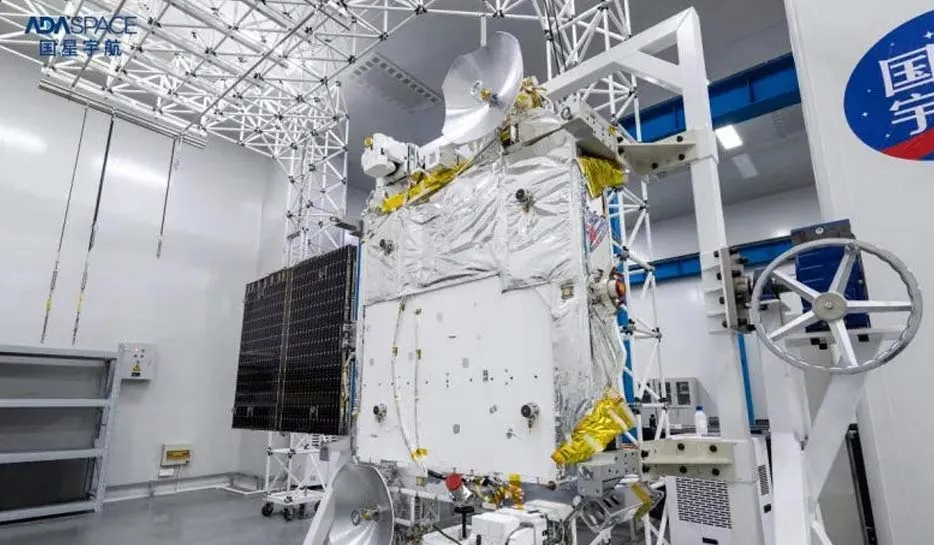
Intuitively, 12 identical satellites should offer 12 times the computing power of one. But the value of connecting the first 12 satellites in Zhejiang Lab’s Three-Body Computing Constellation goes beyond adding up their processors. What creates that extra value? This article examines three sources of collaborative capability—and the costs that come with them.
1. Scheduling: From Waiting for a Pass to Assigning a Task
An individual satellite has a limited number of opportunities to pass over a target area each day. Customers must wait until its orbit brings it within reach. If 12 satellites work independently, they resemble 12 delivery riders each waiting for a suitable order. Connect them through a coordinated scheduling system, and they become a dispatch platform: when a request arrives, the system can identify a satellite with a suitable upcoming observation window and available computing resources.
In queueing theory, pooling resources can reduce waiting times and improve utilization compared with separate queues. The size of that improvement depends on demand, resource availability and scheduling constraints; it is not a guaranteed multiplier. In everyday terms, 12 riders working separately may duplicate effort while some remain idle. A shared dispatch system helps the entire team handle orders more efficiently.
2. Handoffs: Taking on Tasks One Satellite Cannot Finish
Some missions exceed what a single satellite can accomplish within its observation window. Consider emergency mapping across several thousand square kilometers: one satellite may have only a few minutes to collect imagery before moving beyond the target area. A networked constellation can coordinate successive observations, passing task status through inter-satellite links so another suitably positioned satellite can continue the work.
That does not automatically mean uninterrupted imaging. The next satellite must have the right orbit, viewing geometry, sensor and observation conditions. Networking helps coordinate the handoff; it cannot remove those physical constraints.
Similarly, some high-precision positioning applications and repeated monitoring tasks—such as tracking a vessel or following a developing fire—benefit from coordinated observations by multiple satellites. One spacecraft may lack the necessary coverage or geometry, while a constellation can combine complementary observations.
Inter-satellite laser links provide the “baton” for direct handoffs in orbit. Without them, satellites can still coordinate through ground systems, but they have fewer opportunities to exchange data and task status directly in space.
3. Specialization: An Assembly Line in Orbit
The third source of value is easily overlooked: satellites can divide the work by function. In one possible architecture, Satellite A collects imagery, Satellite B processes it in orbit, Satellite C stores and relays the data, and Satellite D handles delivery to a ground station. The system behaves like an assembly line rather than 12 all-purpose workers operating independently.
Specialization allows each spacecraft to focus on its assigned role. A processing satellite may not need a large imaging payload, while a storage satellite may not require the same computing performance. This can simplify individual spacecraft and potentially reduce their costs, although the overall economics also depend on communications hardware, redundancy and system integration.
This is a central idea behind “processing space-generated data in space”: a constellation’s useful capability comes from how its resources are organized, as well as how much computing hardware it carries. The example above illustrates a possible division of labor; it should not be read as the confirmed configuration of the first 12 Three-Body satellites.
Terminology Explained: Distributed Computing
Distributed computing divides a large task among multiple machines that work together, with a network carrying information between them. Large online services—including the digital red-envelope features used in mobile apps—rely on distributed systems to handle many users at once.
In plain English: a coordinated team can tackle work that is difficult for any one member to complete alone. The principle applies both on Earth and in orbit.
The Trade-Off: Coordination Has a Cost
Networking brings benefits, but collaboration is not free. Three costs deserve particular attention:
1. Limited inter-satellite bandwidth. Sending a compact result requires far less bandwidth than transferring raw imagery. Moving data between computing nodes in orbit can encounter its own version of the data transmission bottleneck.
2. Synchronization overhead. Coordination consumes computing resources and time. Divide a task into too many small pieces, and the cost of exchanging messages, maintaining shared state and waiting for dependencies can erode the benefits of parallel processing. The more fragmented the work, the greater the “meeting overhead.”
3. Shared failure risks. A network can spread the impact of faults when multiple satellites depend on the same scheduling software or service. A bug in a shared scheduler could disrupt tasks across the constellation. That makes software reliability especially important, alongside redundancy and fault isolation.
The first 12 satellites of the Three-Body Computing Constellation, with a reported maximum individual computing capability of 744 TOPS, provide a platform for exploring a central engineering question: can the benefits of collaboration outweigh its costs? As constellations grow, that question becomes increasingly important.
Key Data Points
1. Initial constellation: the first batch of the Three-Body Computing Constellation comprises 12 satellites. Zhejiang Lab reported a maximum single-satellite computing capability of 744 TOPS—744 trillion operations per second.
2. Orbital timing: a low Earth orbit satellite typically completes an orbit in roughly 90 minutes, depending on altitude. Its opportunities to observe the same target depend on its orbit, sensor swath and pointing capability; completing an orbit does not mean passing over that target again.
3. Data delivery constraints: the original article cites Guangming Daily on September 24, 2026, for a claim that traditional satellites downlink less than one-tenth of their data. The precise scope of that figure requires confirmation, so it should not be treated as a universal rate for all satellites. The broader issue remains: limited downlink capacity can restrict how quickly collected data becomes usable. Onboard processing and inter-satellite coordination are approaches to easing that bottleneck.
A Question to Explore: Where Does Collaboration Reach Its Limit?
How far can constellation coordination scale? Human operators might help organize a small fleet, but a constellation of 100 satellites requires much greater automation. At 1,000 satellites, AI could increasingly help schedule workloads across other AI-enabled nodes.
When the scheduling system itself becomes one of the most complex pieces of software, could its limitations hold back the constellation’s collective intelligence?
One Idea to Remember
A constellation’s value is more than the sum of its processors. Scheduling, handoffs and specialization are what turn separate satellites into a coordinated system.
For Earth observation customers, the practical value of that coordination is a better path from data collection to a useful answer. STARPATH GLOBAL combines global satellite resources with software, data processing and AI interpretation to support that path, matching imagery and analysis to each application. Whether the goal is monitoring forests, assessing crops or screening infrastructure risks, customers can work with STARPATH GLOBAL to define the coverage, resolution and delivery workflow their decisions require.