China is working to give satellites an additional “brain” by combining artificial intelligence and onboard computing with traditional space capabilities. The objective is not simply to process data in orbit, but eventually to enable autonomous spacecraft, robotic servicing and the construction of large-scale computing infrastructure and human bases in space.
What Is Space-Based Computing?
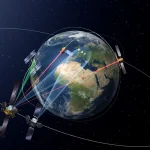
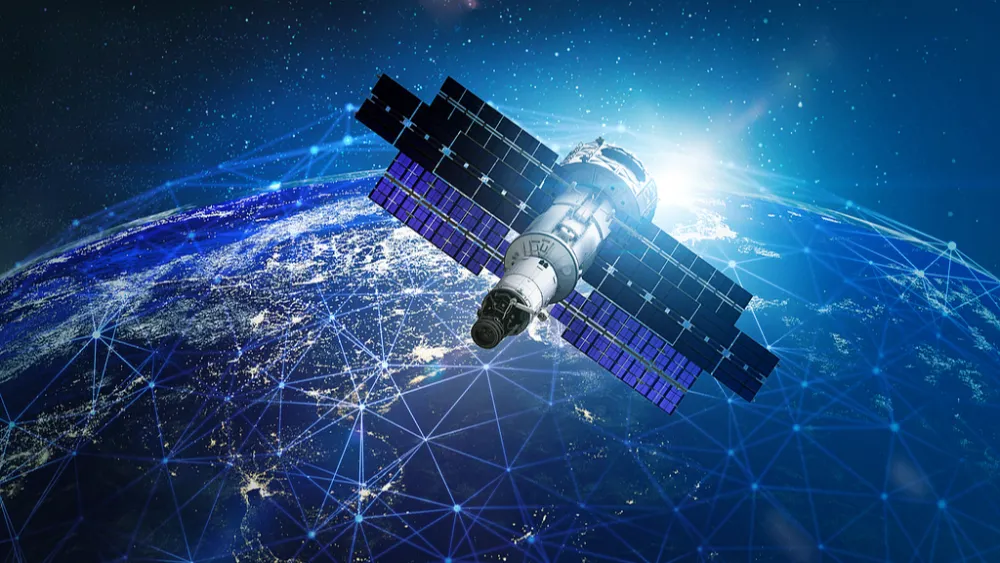
Space-based computing refers to the deployment of computing capacity in orbit, using satellite networks to provide seamless global coverage. Compared with terrestrial data centers, its greatest advantages are real-time processing and extensive geographical coverage.
Its development is being driven by several factors, including explosive demand for AI computing capacity, breakthroughs in reusable rocket technology, and the energy and space constraints facing terrestrial data centers.
Satellites have traditionally been used for communications, navigation, remote sensing and scientific exploration. They collect vast amounts of imagery and other raw data in orbit, transmit it to Earth and rely on terrestrial data centers for processing and analysis—a model sometimes described as “space-based sensing and ground-based computing.”
Space-based computing fundamentally changes that model. By equipping satellites with radiation-resistant chips, storage modules, intelligent computing systems and intersatellite communications equipment, data can be collected, processed and analyzed directly in orbit. Only useful results need to be sent back to Earth, enabling “space-based sensing and space-based computing.”
China’s First Space Computing Constellation

ADA Space’s first 12-satellite orbital cluster under the Xingsuan program.
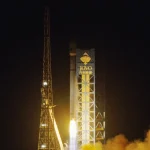
In May 2025, China launched the first 12 satellites of Xingsuan, described as the world’s first space computing satellite constellation, aboard a Long March 2D carrier rocket from the Jiuquan Satellite Launch Center.
Each satellite carries an onboard intelligent computing system and an intersatellite communications system, giving the constellation both space-based computing and networking capabilities. The computing capacity of the initial constellation is already comparable to that of a very small terrestrial computing center.
Zheng Wen, a researcher at the Innovation Academy for Microsatellites of the Chinese Academy of Sciences, compared a computing satellite to sending a laptop into space: data that previously had to be processed on Earth can now be handled promptly in orbit.
China has also achieved the orbital deployment and dynamic updating of general-purpose large AI models. Instead of launching satellites with permanently installed models, operators can transmit new models and algorithms from Earth to spacecraft already in orbit, much like updating the operating system of a mobile phone.
Future satellite clusters could pool their resources to provide unified computing capacity. Zheng said one long-term vision is to build an enormous computing center directly in space, potentially involving a spacecraft measuring 4,000 meters by 4,000 meters and providing computing services as a piece of orbital infrastructure.
Why Move Computing into Space?
Terrestrial computing remains more mature and offers enormous processing capacity, making it suitable for large-scale AI training, industrial simulations and other intensive applications. However, data centers face physical and economic constraints.
Electricity can account for 40% to 60% of a large data center’s operating costs, while cooling systems require additional energy and investment. Land availability and limitations on power-grid capacity have also created obstacles to data-center expansion.
Space offers continuous access to solar energy without atmospheric attenuation. The side of a spacecraft facing away from the Sun can also remain relatively cold, offering certain potential advantages for thermal management.
Satellite computing networks are also unaffected by the geographical limitations of terrestrial base stations and fiber-optic infrastructure. A sufficiently large constellation could provide seamless global coverage, including over oceans, polar regions, deserts and plateaus where ground networks are limited or unavailable.
These advantages make space-based computing particularly valuable for remote sensing.
A single high-resolution satellite image can contain several gigabytes or even tens of gigabytes of data. Under the traditional model, satellites must wait until they enter the coverage area of a ground station before transmitting this information. Sending and processing the raw data can take several hours.
Such delays can dramatically reduce the value of information in emergencies. By the time satellite imagery of a forest fire has been transmitted and analyzed, the blaze may have spread several kilometers. After an earthquake, delays in processing images can consume valuable rescue time.
With onboard computing, a satellite could identify fires, collapsed buildings or other important targets within seconds and send only their locations and other essential information to Earth. This could improve emergency-response efficiency by several orders of magnitude.
Contact STARPATH GLOBAL’s FDE engineers to discuss how our space-based computing capabilities can meet your remote-sensing and mission requirements.
Heat and Radiation Remain Major Obstacles
The space environment also creates severe engineering challenges. According to Zheng, heat dissipation and high-energy particle radiation are the two principal obstacles preventing the large-scale deployment of space computing.
Because space is almost a vacuum, there is no air to carry heat away through convection. Spacecraft must dissipate heat through thermal radiation, meaning a large orbital computing center would require an enormous radiator surface.
High-energy particles pose another threat. Computers process information through binary states represented by zeros and ones. When high-energy particles penetrate a chip, they can alter these electronic states, turning a zero into a one or an “on” state into an “off” state. Such changes can corrupt calculations and produce unusable output.
Space computing systems therefore require radiation-resistant hardware, fault-tolerant designs and advanced thermal-management technologies.
From Smarter Satellites to Autonomous Spacecraft
Sending computing power into orbit is not the final objective. It is a crucial step toward autonomous intelligence in space.
One potential application is the robotic arm aboard the China Space Station. Giving the arm its own computing “brain” could eventually allow it to carry out extravehicular operations in place of astronauts, reducing risks and increasing operational efficiency.
Scientists also want future satellites and spacecraft to complete more complex tasks independently. The Innovation Academy for Microsatellites of the Chinese Academy of Sciences is designing a future spacecraft known as NEZHA.

Inspired by the figure from Chinese mythology, NEZHA is envisioned as a transformable spacecraft with “three heads and six arms.” It would be capable of autonomous flight and could use its additional robotic arms to repair satellites that have malfunctioned or exhausted their energy supplies.
By deeply integrating AI, computing capacity and satellite platforms, researchers ultimately hope to create spacecraft that can perceive their surroundings, make decisions and perform operations without constant instructions from Earth.
Applications on Earth
Space-based computing could also have a substantial effect on life on Earth.
Oceans cover 71% of the planet, but most areas have no terrestrial radar or communications coverage. When a vessel moves beyond the range of shore-based systems and switches off its Automatic Identification System, its activities may remain unknown unless a satellite happens to photograph it.
Real-time orbital processing could make vessels detectable anywhere in the world. AI systems could analyze what a ship is doing and potentially predict its next actions, providing new tools to combat illegal fishing and improve maritime monitoring.
Weather forecasts could be updated every few minutes rather than every several hours, allowing earlier warnings of typhoons and extreme rainfall. Agricultural systems could monitor crop growth field by field and detect pests, diseases, droughts and flooding risks at an earlier stage. Explore industry applications →
Navigation and autonomous-driving services could also benefit from reduced latency and improved reliability.
Beyond efficiency and performance, space-based computing also has strategic significance. It could serve as a reliable backup if terrestrial networks are disrupted and provide essential computing support for future deep-space exploration missions.
Space-based computing is also becoming part of the competition for orbital positions and radio-frequency resources. Under international rules, high-quality orbital and spectrum resources are generally allocated on a first-come, first-served basis. Early deployment could therefore give countries a lasting advantage in the development of future space infrastructure.
China’s space computing program remains at an early stage. Researchers must still overcome major challenges involving heat, radiation, data security and space-ground coordination. Nevertheless, the technology could eventually support a distributed computing network surrounding Earth—and provide the intelligent infrastructure required to build human bases in space.