Space computing covers three distinct approaches: satellites that process their own observations, constellations that share computing tasks in orbit, and orbital infrastructure designed to handle workloads originating on Earth. They share a label, but their technical requirements and commercial readiness differ substantially.
This lesson maps out the three approaches, making it easier to understand where each new space computing announcement fits.
Approach 1: Onboard Intelligence—Making Each Store Viable
Think of a retail chain: before expanding, it needs to establish whether an individual store can sustain itself. Onboard intelligence follows the same logic. A satellite carries its own AI computing hardware, captures observations, processes them and produces results.
Examples include S-AIDC-1, introduced in Lesson 101, which is designed to shorten Earth observation response times from hours to minutes, and PEGA-SUS1, a technology demonstration satellite integrating communications, sensing and intelligent computing.
This is the most commercially mature of the three approaches. It does not require a networked constellation or inter-satellite links: a single satellite can deliver useful results independently. Huafu Securities identifies onboard intelligence as an area with established applications.
Approach 2: Processing Space Data in Space—Connecting the Stores
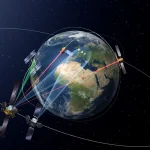
Once individual stores are viable, a retail chain can connect them to share inventory and coordinate operations. Processing space data in space applies that logic to satellites. Dozens or hundreds of computing satellites could form a network, exchange data through laser links and coordinate processing tasks in orbit.
The aim is to move from intelligent individual satellites to an intelligent constellation. Lesson 7 of Course 201 will explain how collaboration can make the whole system more capable than the sum of its parts.
A leading example is Zhejiang Lab’s Three-Body Computing Constellation, whose first 12 satellites have formed an orbital network, with reported peak computing performance of up to 744 TOPS per satellite—744 trillion operations per second. S-AIDC has also announced plans to deploy its computing constellation at scale.
Huafu Securities assesses this approach as moving from technical validation toward commercialization. It is likely to be a major focus of space computing development over the next five years.
Approach 3: Processing Earth Data in Space—Moving the Warehouse into Orbit
The third approach is more ambitious: move some workloads currently handled by terrestrial data centers into space. Rather than primarily processing satellite observations, orbital infrastructure would process data and computing tasks originating on Earth. Google’s Project Suncatcher, discussed in Lesson 2, represents this direction.
This approach also faces some of the toughest physical constraints. Heat must ultimately be rejected into space through radiation, making sustained computing performance dependent on thermal design. Power budgets on small computing satellites can be in the kilowatt range, while high-density terrestrial racks can draw tens of kilowatts. Launch costs also make every kilogram of computing hardware, power equipment and cooling infrastructure consequential.
Huafu Securities describes this as a potential long-term development direction. In practical terms, the concept may prove viable, but it remains early in its development. Its progress should not be used as a benchmark for the entire space computing industry.
A Quick Guide to the Three Approaches
Key Evidence
1. Huafu Securities: Onboard intelligence already has established applications; processing space data in space is moving from technical validation toward commercialization; and processing Earth-originated workloads in orbit could become a long-term development direction. The firm identifies 2026 as a potential turning point from validation toward industrial deployment.
2. China Academy of Information and Communications Technology: Its 2026 outlook report on space computing describes infrastructure combining in-orbit sensing, intelligent processing and coordination between space and ground as a strategic frontier attracting investment from major countries.
3. Zhijiang Lab: The first 12 satellites of the Three-Body Computing Constellation have formed a network, with reported peak computing performance of up to 744 TOPS per satellite.
For organizations planning an Earth observation service, the practical starting point is the information they need, how quickly they need it and which processing approach can meet those requirements. Drawing on China’s expanding satellite supply chain, STARPATH GLOBAL helps international customers evaluate competitively priced imagery, payloads and satellite options suited to their applications. To discuss your monitoring requirements and assess where onboard processing could add value, contact the STARPATH GLOBAL team; organizations building their first remote sensing workflow can also explore our Pioneer Partner Program for support from Forward Deployed Engineers and staff training.