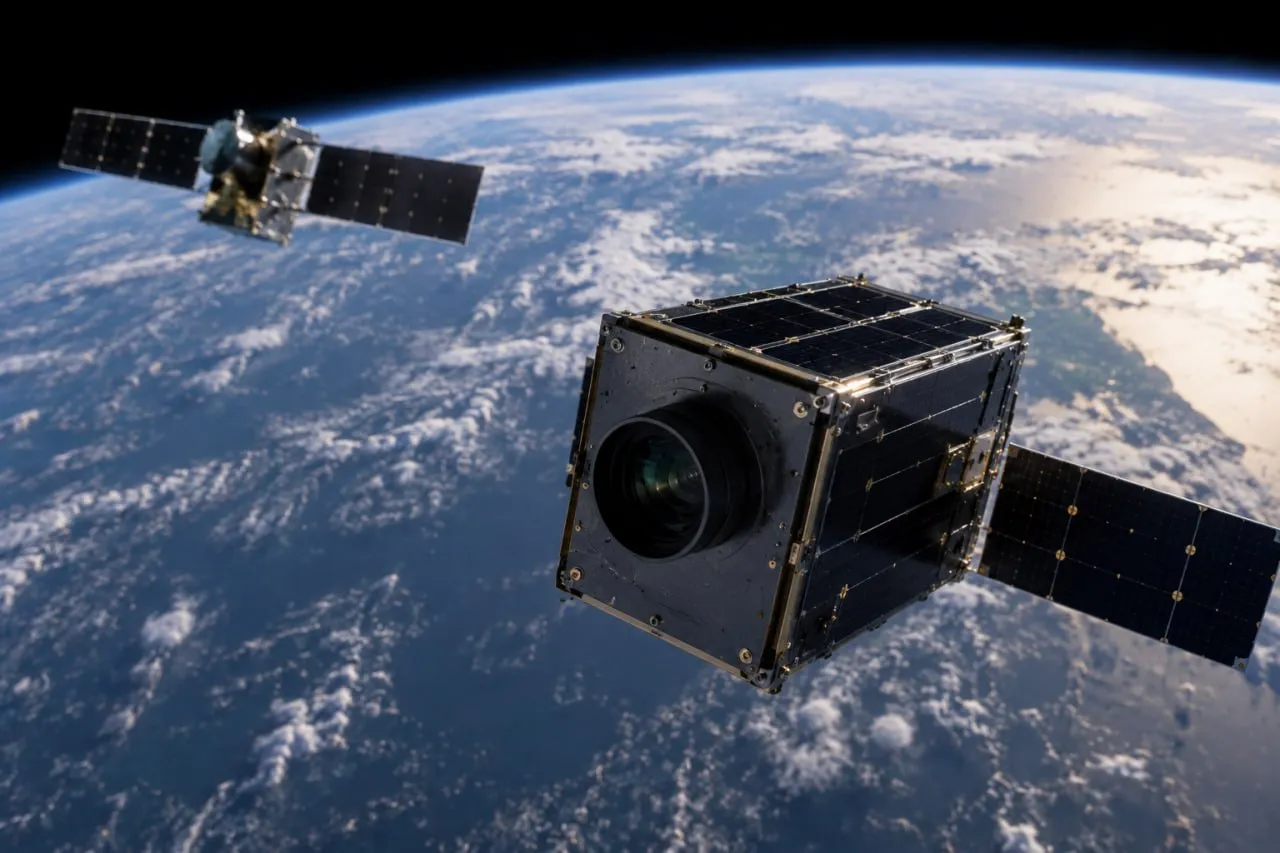
Diffraqtion has secured strategic investments from Lockheed Martin Ventures and Presidio Ventures, the venture arm of Sumitomo Corporation, bringing the quantum imaging startup’s total funding to more than $10 million.
Announced on August 31, 2026, the financing will support development of Diffraqtion’s first fielded camera and a planned hosted-payload mission intended to establish flight heritage. The Somerville, Massachusetts-based company is targeting space domain awareness, reconnaissance and other applications in which optical resolution must be balanced against sensor size, mass and processing requirements.
Diffraqtion capped its pre-seed round after attracting additional investor interest. The financing also includes SBI US Gateway Fund with Plug and Play, Collaborative Fund and TekVentures. Existing investors Aether VC, milemark•capital and ADIN provided follow-on capital.
The latest commitments follow the round’s initial close, led by Ground State Ventures and announced in January 2026. Diffraqtion is a spinout rooted in research at the Massachusetts Institute of Technology and the University of Maryland.
From laboratory optics to a fielded quantum camera
Diffraqtion is developing a sensing architecture designed to extract spatial information that conventional cameras generally discard. Standard imaging systems primarily measure the intensity of light across an array of pixels. Diffraqtion instead sorts incoming light according to its spatial shape and applies machine-learning models to interpret the resulting optical signatures.
The approach draws on quantum estimation theory but is not a quantum computer. It does not require qubits, entangled light sources or cryogenic cooling, distinctions that could make it more practical for spacecraft, aircraft and terrestrial systems than technologies requiring tightly controlled laboratory environments.
Its objective is to distinguish features below the conventional diffraction limit—the resolution boundary imposed by an optical system’s aperture and the wavelength of observed light. Diffraqtion says simulations indicate its technology can resolve features up to 20 times smaller and classify targets orders of magnitude faster than conventional imaging pipelines.
Those figures remain company-reported performance projections rather than results from an operational space mission. Translating them into deployable capability will require validation across representative targets, lighting conditions, pointing errors, vibration and sensor noise.
Diffraqtion has completed on-sky demonstrations at a partner observatory, where its system distinguished closely spaced objects. Its DARPA Direct-to-Phase-II Small Business Innovation Research project has also entered a second option period.
NASA selected the company for a Phase I SBIR project focused on tracking orbital debris. Diffraqtion separately won NASA’s $100,000 Space to Soil Challenge for an adaptive sensing and onboard-processing concept.
The company has appointed Peter Kazlas as head of engineering to lead the transition into fielded hardware. Kazlas has 25 years of experience developing and commercializing optical technologies, including roles at E Ink and quantum-dot display company QD Vision, which Samsung acquired.
Smaller apertures could reshape space sensing economics
Optical resolution in space has traditionally depended heavily on aperture size. Larger apertures can collect more light and resolve finer angular detail, but they also add mass, volume, structural complexity and cost. Their supporting spacecraft may need tighter pointing stability, more demanding thermal control and larger launch accommodations.
A sensing method that delivers useful detection or classification performance with a smaller aperture could therefore produce benefits extending beyond the camera itself. It could enable a lighter payload, reduce structural and thermal-control requirements, or permit more sensors to fly on smaller spacecraft.
The distinction between reconstructing a conventional image and identifying mission-relevant information is particularly important. Some defense and space-surveillance missions do not require a visually complete picture; operators may instead need to determine whether multiple objects are present, detect motion, characterize a target or generate an alert.
Diffraqtion’s architecture is designed around that task-oriented model. Its optics encode a compact signature of the observed scene, while onboard algorithms produce classifications or other actionable outputs. Processing at the sensor could reduce the volume of raw imagery sent to the ground and shorten the interval between observation and response.
That combination would be relevant to space domain awareness, where sensors must detect and discriminate distant objects under limited photon availability. It could also support airborne intelligence, surveillance and reconnaissance; geospatial intelligence; autonomous navigation; and industrial inspection.
However, optical innovation does not eliminate spacecraft-level constraints. A flight unit will still need to survive launch vibration and shock, operate across orbital temperature cycles, control stray light and radiation effects, and maintain calibration throughout the mission. Its algorithms must also demonstrate reliable performance on targets and backgrounds that differ from training or laboratory datasets.
Hosted payload will be the critical validation step
Diffraqtion plans to establish flight heritage through a hosted payload aboard a partner spacecraft, although it has not disclosed the spacecraft provider, launch date, orbit or payload configuration.
A hosted mission can give the company access to launch and spacecraft resources without financing an entire satellite. More importantly, it will provide an opportunity to compare quantum-camera outputs with known targets and conventional sensors under actual orbital conditions.
The demonstration will need to show that the optical hardware, calibration system and onboard processing chain remain stable after launch and through repeated thermal cycles. For prospective defense and commercial customers, repeatable performance and low false-alarm rates will be as important as maximum resolution achieved in a controlled test.
Lockheed Martin Ventures’ participation gives Diffraqtion a strategic investor with direct exposure to defense, space and airborne sensing programs. Lockheed Martin Ventures Vice President and General Manager Chris Moran said the technology could improve target detection and classification while supporting smaller and more efficient sensing systems.
Presidio Ventures adds a potential route into industrial and international commercial markets through Sumitomo Corporation. The same underlying architecture could be applied to Earth observation, robotic guidance and precision inspection if the company can package the technology into reliable, manufacturable cameras.
The investment moves Diffraqtion into a more difficult phase of development: converting a physics-based sensing concept into qualified hardware that customers can integrate into operational platforms. The planned hosted payload will be the first major test of whether its sub-diffraction approach can deliver a meaningful system-level advantage outside the laboratory.