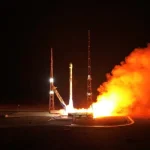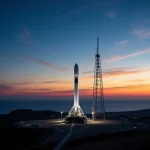
NASA’s Nancy Grace Roman Space Telescope launched aboard a SpaceX Falcon Heavy on August 30, beginning a three-month journey to a gravitationally stable observing location nearly one million miles from Earth.
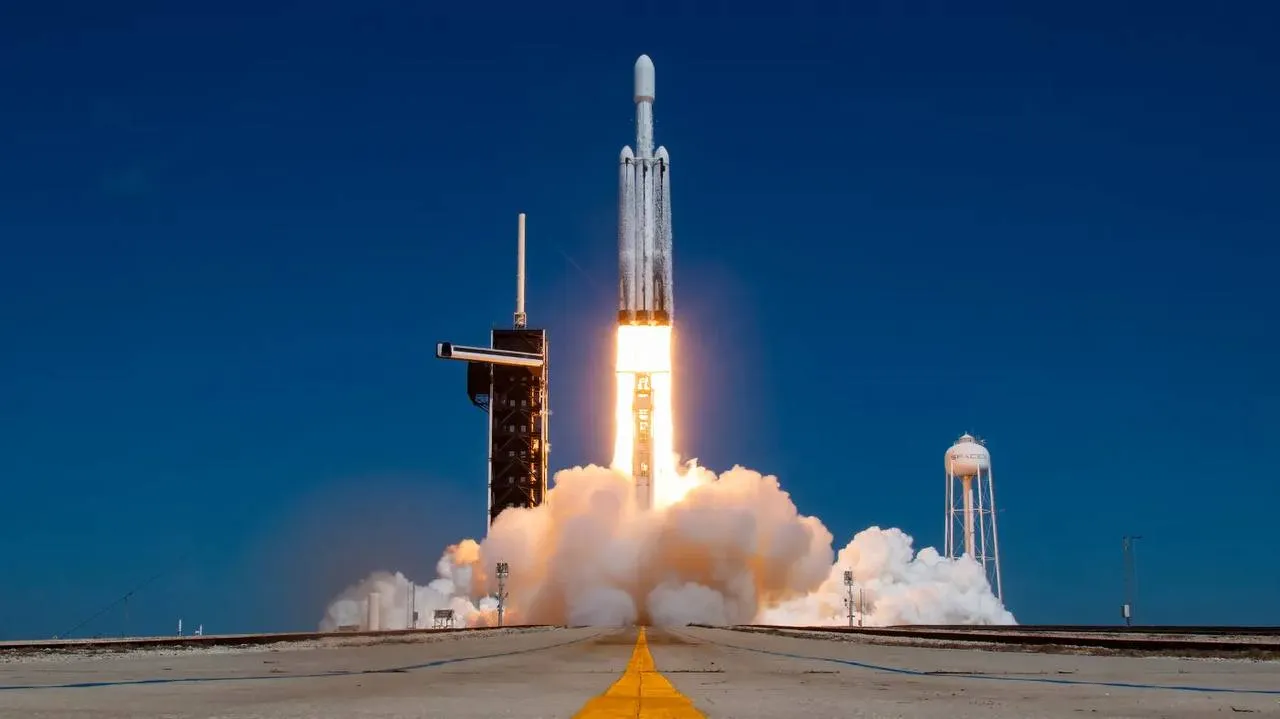
The rocket lifted off at 7:26 a.m. EDT from Launch Complex 39A at NASA’s Kennedy Space Center in Florida. Roman separated from Falcon Heavy’s upper stage 31 minutes after liftoff, completing the launch phase of a flagship astrophysics mission designed to investigate dark energy, dark matter, exoplanets and the evolution of the universe.
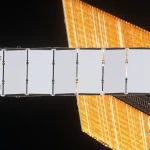
Controllers at NASA’s Goddard Space Flight Center in Maryland began receiving telemetry from the observatory seven minutes after launch. Roman’s solar arrays and lower instrument sunshade deployed successfully one hour and 23 minutes into the mission, establishing the power and thermal configuration needed for its cruise to the second Sun-Earth Lagrange point, or L2.
Falcon Heavy sends Roman toward L2
Falcon Heavy’s 27 Merlin engines generated more than 5 million pounds of thrust at liftoff. The two side boosters shut down approximately two minutes and 24 seconds into flight, separated from the center core and returned to Cape Canaveral Space Force Station.
Both boosters landed near the launch site for potential refurbishment. One was flying for the first time, while the other completed its third mission after supporting the GOES-U and Viasat-3 F3 launches. The center core was expended.
Following center-core separation, Falcon Heavy’s second stage performed the burns needed to place Roman on its departure trajectory. The flight was the fourth primary NASA mission launched on Falcon Heavy. NASA’s Launch Services Program and SpaceX had accelerated the mission to take advantage of Roman’s completion ahead of its previous schedule.
Roman initially communicated through NASA’s Near Space Network, which provides tracking, telemetry and command links during launch and early flight. About 70 minutes after liftoff, communications responsibility shifted to the Deep Space Network.
The Canberra Deep Space Communication Complex in Australia established the first deep-space connection, followed by planned handovers to Madrid in Spain and Goldstone in California. This sequence provides overlapping coverage while controllers assess spacecraft health and refine its trajectory.
During the first days of flight, Roman is scheduled to deploy its high-gain antenna and visor-like deployable aperture cover. Controllers will also command the first of two planned midcourse corrections and power on the Coronagraph Instrument.
A wide-field observatory built for survey science
Roman combines a 2.4-meter primary mirror—approximately the same diameter as Hubble’s—with an optical system optimized for wide-field imaging. Its view is at least 100 times wider than Hubble’s while retaining comparable angular resolution.
The observatory’s primary payload, the Wide Field Instrument, is a 300-megapixel infrared camera equipped with 18 detectors. It is expected to switch on several weeks into the cruise phase, after the spacecraft completes its initial deployments and engineering checks.
Roman’s combination of aperture, field of view and rapid repointing is designed to survey the universe as much as 1,000 times faster than Hubble. Its main cosmology survey is expected to cover more than two billion galaxies, supplying the statistical sample required to trace how cosmic structure and expansion changed over time.
That survey architecture differentiates Roman from the James Webb Space Telescope. Webb is optimized for highly sensitive observations of comparatively narrow fields and individual targets, while Roman will repeatedly image much larger regions. Roman can therefore identify rare objects and transient events at scale, creating target catalogs that Webb, Hubble and ground-based observatories can examine in greater detail.
Roman will use several complementary techniques to study dark energy, including measurements of galaxy distributions, gravitational lensing and distant Type Ia supernovae. Comparing these independent observations should help researchers test models of the universe’s accelerated expansion while reducing reliance on any single measurement method.
The same datasets will map the distribution of dark matter through its gravitational effects on visible galaxies. Roman will not detect dark matter directly, but the distortion and clustering of background objects can reveal how unseen mass is distributed across large volumes of the universe.
Exoplanet census and coronagraph demonstration
Roman will also conduct a large microlensing survey toward the densely populated center of the Milky Way. Gravitational microlensing occurs when a foreground star and its planets briefly magnify the light of a more distant star. Because the technique does not depend on light emitted or reflected by the planet, it can detect worlds at orbital distances and masses that are difficult to reach with transit surveys.
The resulting sample is intended to provide a statistical census of planetary systems, including planets orbiting far from their stars and potentially free-floating worlds that are not gravitationally bound to any star.
Its second payload, the Coronagraph Instrument, is a technology demonstration rather than a primary survey instrument. The coronagraph will suppress the glare of nearby stars so Roman can directly image and characterize Jupiter-like exoplanets and circumstellar material.
High-contrast imaging requires extremely precise control of the telescope’s optical wavefront because small distortions can allow starlight to leak into the observation. Roman’s demonstration will test active wavefront-control technologies in space and help reduce technical risk for future observatories, including NASA’s proposed Habitable Worlds Observatory, which is intended to search for potentially Earth-like planets.
Commissioning shifts the risk from launch to calibration
Reaching L2 is only the beginning of Roman’s commissioning campaign. Controllers must verify the spacecraft’s pointing stability, thermal behavior, communications performance and instrument alignment before science operations can begin.
Operating near L2 offers a comparatively stable thermal and viewing environment because the Sun, Earth and Moon remain in roughly the same direction from the spacecraft. A sunshield can therefore keep the telescope’s instruments cold while Roman maintains long observing campaigns. The location does not eliminate stationkeeping requirements, however, and controllers will periodically adjust the observatory’s orbit around L2.
During the remainder of the three-month commissioning period, engineers and scientists will calibrate the instruments, characterize detector response and confirm optical performance across the Wide Field Instrument’s large focal plane. These activities are especially important for weak-lensing measurements, where subtle detector or optical effects could be mistaken for the tiny distortions caused by dark matter.
NASA expects to release Roman’s first images in early 2027.
Once science operations begin, Roman is expected to return about 1.4 terabytes of data per day—the highest data rate yet planned for a NASA astrophysics mission. Processing that volume will require automated pipelines, extensive data calibration and rapid distribution to the research community. Machine learning, artificial intelligence and citizen-science programs are expected to help identify transient, unusual or otherwise scientifically valuable objects.
The nominal science mission is planned for five years. Roman is managed by Goddard, with participation from NASA’s Jet Propulsion Laboratory, Caltech/IPAC and the Space Telescope Science Institute. BAE Systems, L3Harris Technologies and Teledyne Scientific & Imaging are the principal industrial partners. ESA, JAXA, France’s CNES and Germany’s Max Planck Institute for Astronomy also contributed to the program.