The safety margin for operating the International Space Station (ISS) is shrinking to an “alarming” level as aging hardware and limited replacement options continue to challenge long-term operations, NASA’s Aerospace Safety Advisory Panel has warned.
Astronomy
Speaking during a panel meeting, chair Susan Helms said it is becoming increasingly difficult for NASA to maintain sufficient contingency margins for routine operations aboard the orbiting laboratory.
“It is increasingly difficult for NASA to ensure the ISS risks remain manageable for day-to-day operations, with enough contingency margins.”
Aging Hardware Requires Ongoing Maintenance
The International Space Station has supported continuous human presence in orbit for more than 25 years, serving as a platform for scientific research, technology demonstrations and commercial experiments.
However, many of its core systems are now decades old and require increasingly frequent maintenance.
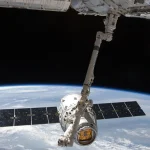
Astronauts are scheduled to conduct a spacewalk to repair Canadarm2, the station’s robotic arm, which plays a key role in supporting cargo spacecraft operations.
NASA officials said Canadarm2 was designed with replaceable components to allow maintenance throughout its operational life.
SpaceTechnology
The agency also acknowledged growing concerns over the aging inventory of spacesuits used for spacewalks. NASA currently has four operational suits aboard the ISS, with another scheduled for delivery later this year.
Transition to Commercial Stations Remains Uncertain
The station has also experienced recurring air leaks in recent years. Earlier this month, astronauts temporarily sheltered inside a SpaceX Dragon spacecraft while Russia’s Roscosmos evaluated repair options before deciding against intervention. NASA said the situation is currently stable.
At the same time, NASA continues working toward replacing the ISS through its Commercial Low Earth Orbit Destinations programme, which aims to transition research activities to privately operated space stations after the ISS is retired around 2030.
The programme has faced delays after NASA postponed Phase 2 contract awards last year. Earlier this year, the agency proposed adding a government-owned module to future commercial stations, citing concerns about market demand, before later reaffirming its original commercial-led approach.
Separately, the U.S. Government Accountability Office has warned that delays in developing successor platforms could create a gap in American low Earth orbit research capabilities after the ISS is retired, potentially allowing China to expand its presence in the sector.