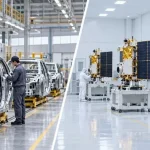
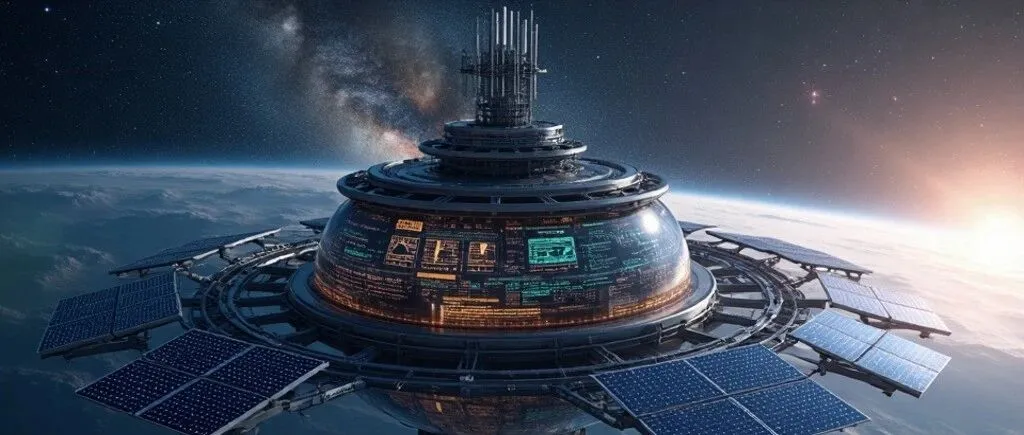
Moving a data center into space sounds like science fiction. But by 2026, a satellite carrying an NVIDIA H100 GPU has already trained an AI model in orbit, and investors have valued the company behind it at $2.3 billion. This article examines the accounting: where revenue comes from, where costs accumulate, and what it would take to break even.
The Drivers: Three Barriers Facing Ground-Based Data Centers
Explosive growth in AI computing demand is pushing ground-based data centers against three increasingly formidable barriers.
- Power. A gigawatt-scale data center requires electricity on the scale of a medium-sized city. Grid expansion takes years, while AI advances in months. SpaceX’s AI satellite plans and OpenAI’s ambitious Stargate project are responses to the same underlying constraint.
- Cooling. Removing the heat generated by GPUs running at full power can require substantial electricity and water. Space offers an environment for radiative heat rejection: without an atmosphere, heat must be released into space as infrared radiation. Cooling-water shortages disappear, but heat rejection becomes constrained by radiator area and operating temperature—a challenge we will explore next week.
- Land and Permitting. Land acquisition, environmental reviews, community opposition and carbon constraints are adding friction to the expansion of computing infrastructure. In orbit, there are no next-door neighbors.
The appeal of space is therefore straightforward: potentially near-continuous solar power in suitable orbits, heat rejection without cooling-water consumption, and no land acquisition costs. Solar arrays can track the Sun, although that does not eliminate eclipses in every orbit. Starcloud projects energy costs roughly one-tenth those of ground-based facilities. That is a company projection, and its underlying assumptions deserve closer examination.
Revenue: Three Ways to Sell Orbital Computing
The pattern is revealing: the closer the business model is to established demand on Earth, the more mature it is. In-orbit inference extends the application value chain discussed in September and addresses an existing need. Compute rental depends on orbital computing eventually achieving lower unit costs than ground-based alternatives. In-orbit training is the longest-term bet.
Costs: Four Major Cost Drivers
- Launch Costs—the Dominant Item. Transport costs of thousands of dollars per kilogram set a floor beneath the capital expenditure required for a space-based data center. The economics ultimately depend on whether heavy-lift vehicles such as Starship can deliver low-cost, frequent launches. Starcloud itself acknowledges that without those launch economics, the business model must be recalculated.
- The Cost of Adapting Hardware for Space. Commercial GPUs face radiation exposure and thermal cycling in orbit. Sending them into space without suitable protection creates reliability risks, while comprehensive qualification and hardening can undermine the cost advantage. The current compromise is commercial components combined with selective protection and ruggedized packaging. Their reliable operating lifetime in orbit still requires validation.
- Thermal Hardware. Radiative cooling can require extensive radiator surfaces. Next week, we will examine an illustrative estimate of roughly 1.4 square meters of radiator area for one H100 GPU, subject to assumptions about power consumption, radiator temperature, emissivity and the orbital environment. Computing density is therefore constrained by how much effective radiator area a system can provide per kilogram.
- Limited Maintainability. Without an orbital servicing capability, hardware failures must be managed through redundancy, reduced functionality or replacement of the satellite. A key advantage of ground-based data centers—the ability to walk into the facility and replace a failed drive—is absent. Operators must recover their launch and hardware investment within the system’s usable operating lifetime.
Comparing the Economics: Ground-Based vs. Orbital Data Centers
The accounting points to a practical conclusion: orbital data centers currently face substantial disadvantages in general-purpose cloud computing, while offering specific advantages for edge inference close to orbital data sources. Their clearest near-term market is the share of workloads in which data originates in orbit and downlink bandwidth is a significant constraint.
Outlook: A Scenario, Not an Established Outcome
Investors have already placed their bets. Starcloud raised $170 million in Series A funding in March 2026 at a $1.1 billion valuation, reaching unicorn status exceptionally quickly after graduating from Y Combinator. In August, it raised a further $250 million in a Series A extension at a $2.3 billion valuation. NVIDIA participated, with its contribution reported at $25 million.
Those valuations reflect expectations about the future. They do not establish that the business can generate a profit.
Our assessment is that 2027–2028 will be a critical test period, as Starcloud-2 and Starcloud-3 progress and Crusoe’s planned commercial orbital computing services come into operation. If measured unit costs and availability fall substantially short of the advertised benefits, the sector could face its first significant reassessment of valuations. This is a forward-looking scenario, offered for consideration rather than presented as an established outcome.
Conclusion
Moving data centers into space is an edge-computing proposition in the near term and an energy proposition over the longer term. Between the two sits the launch bill. The economics ultimately depend on unit costs—and the next two years should provide a much clearer picture of whether those costs can support a viable business.
For organizations using satellite data today, the same discipline applies: match the data and processing approach to the decision you need to make. STARPATH GLOBAL draws on China’s expanding satellite capacity to provide competitively priced imagery and help customers choose a resolution suited to their application and budget. Discuss your monitoring requirements with STARPATH GLOBAL to assess a practical workflow, while teams building their remote-sensing capabilities can explore the Pioneer Partner Program for support from our Forward Deployed Engineers.